
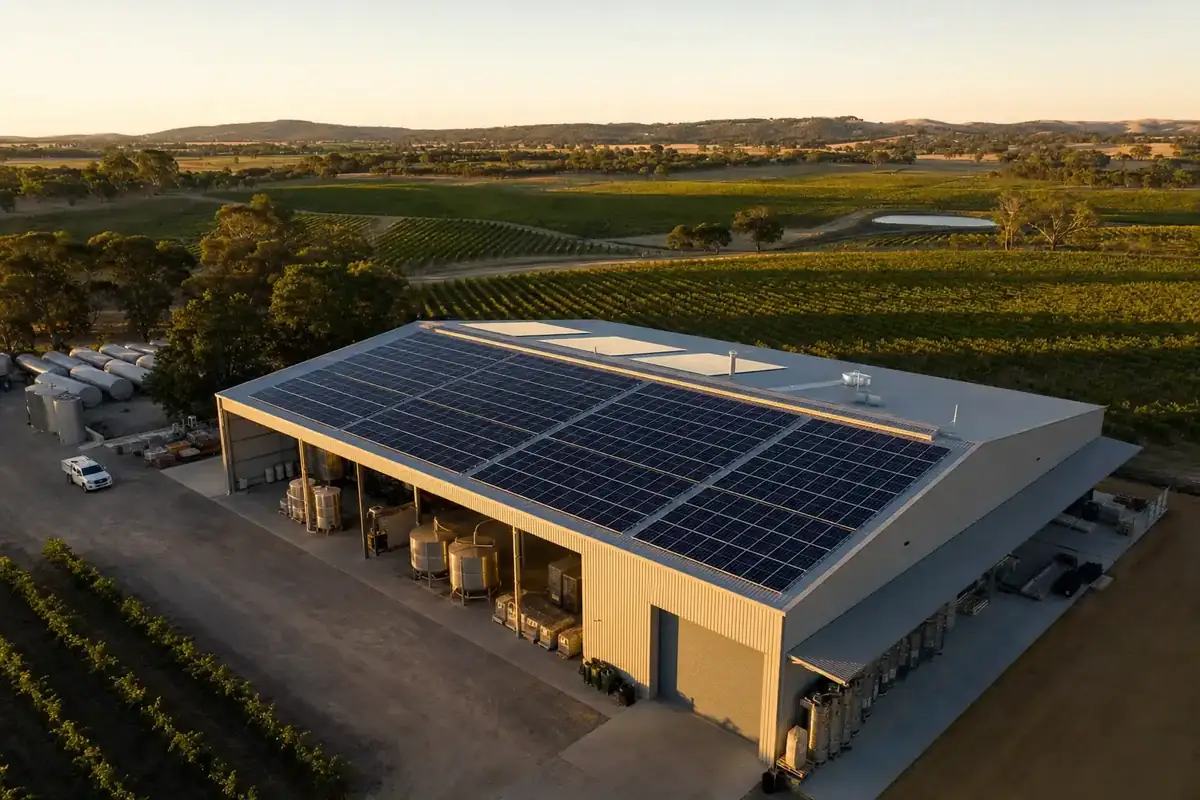
Commercial Solar for SA Agribusiness & Wineries
South Australia's wine, grain, and horticulture sectors carry seasonal energy loads that align well with solar generation. We engineer systems around your harvest peak, not a generic commercial template.
 4.9Google rating328 reviews
The load profile
Why solar fits agribusiness & wineries
South Australia produces around half of Australia's premium wine and a significant share of its grain, fruit, and vegetable exports. The energy costs behind that output - powering crush facilities, barrel halls, cool rooms, irrigation pumps, grain augers, and packing lines - are a controllable cost item that solar can reduce substantially.
Agribusiness energy loads are often seasonal, peaking during vintage (February to May for most SA wineries), harvest, or summer irrigation periods. A solar system sized to the peak load, combined with understanding of the off-peak consumption pattern, produces the most accurate return model.

Vintage and Harvest Peak Load
SA wineries draw heavily on crush equipment, refrigeration, and pump systems from February through May. SA grain operations peak at harvest from October to January. Solar generation is strong across both periods.
Irrigation Pump Load in Summer
Drip and overhead irrigation systems on SA farms and vineyards draw significant daytime load across summer months - directly aligned with peak solar generation in the state's strongest irradiance window.

Year-Round Cold Storage Draw
Winery barrel halls, bottled wine storage, and fruit cool rooms run year-round. Solar offsets the daytime refrigeration load and battery storage extends that offset through peak tariff windows.
The numbers
Commercial solar economics for agribusiness & wineries
Indicative ranges only. Actual sizing is determined by site-specific load analysis.
| Operation Type | Key Energy Load | Solar Alignment | Typical System Range |
|---|---|---|---|
| SA winery (500-2,000t crush) | Crush, refrigeration, barrel hall, bottling | Strong during vintage Feb-May; year-round refrigeration | 50kW - 300kW |
| Large grain operation | Augers, conveyors, drying plant, workshop | Strong during Oct-Jan harvest; year-round workshop and shed load | 30kW - 200kW |
| Irrigated horticulture (fruit, almonds, olives) | Irrigation pumps, packing lines, cool rooms | Excellent in summer - pumps run in solar hours | 30kW - 500kW |
| Dairy or livestock operation | Milking plant, water heating, cooling, ventilation | Moderate - some evening load that reduces solar offset | 20kW - 100kW |
Indicative figures. Your written proposal models your exact site.
Why it matters
A generic install leaves money on the roof
For a agribusiness & wineries site, the difference between a catalogue system and a load-matched one is years off your payback.
A generic installer
- Sized to your roof area, not your actual load
- Priced per kW off a catalogue
- One-size panel + inverter bundle
- Demand charges ignored
- Handed off the day it's switched on
Our load-matched approach
- Sized to your real interval data
- Costed line by line for your site
- Panels + inverter matched to your load profile
- Battery + design target peak-demand charges
- Monitored and serviced by the same team
Solar built for agribusiness & wineries?
Get a free quote. We model the system, savings and payback before you commit to anything.
How we'd approach your site
From power bill to payback
 01
01Load analysis
We pull your interval data and map exactly how and when the site draws power.
 02
02System design
Array, inverter and battery sized to that load, modelled for real generation and self-consumption.
 03
03CEC install
Licensed, insured, in-house installation to SA grid rules, planned around your operating hours to keep disruption to a minimum.
04Monitor & service
Live performance monitoring so the return you were quoted is the return you keep.
What we deliver
Services for agribusiness & wineries

Commercial Solar Panels & Systems
Engineered rooftop PV from 30kW to 1MW+, sized to your load profile.
Learn more
Commercial Battery Storage
Store daytime generation to slash peak-demand charges and add backup.
Learn moreEnergy Audits & Feasibility
Load analysis and ROI modelling before a single panel is ordered.
Learn moreIn detail
Solar for agribusiness & wineries, in detail
The SA wine industry runs on electricity. Crush and press equipment, refrigeration for fermentation temperature control, barrel hall climate control, bottling lines, and cellar door HVAC all contribute to a significant annual energy bill. For a medium-sized winery processing 500-2,000 tonnes of fruit, that bill can reach $80,000-$250,000 per year at current SA tariff rates.
The vintage load profile - February to May for most SA wineries - concentrates the highest energy demand in a four-month period. A correctly sized solar system covers a substantial share of that peak load, then continues generating revenue through the remaining eight months when winery consumption drops to a lower, steadier baseline.
Cellar Door and Tourism Load
Cellar doors, restaurants, and accommodation attached to SA wineries carry a daytime visitor load that aligns well with solar generation. HVAC for tasting rooms, kitchen equipment, and lighting in sales areas run during opening hours. Solar reduces the cost of hosting those visitors, which is a direct margin improvement on cellar door revenue.
An increasing number of SA wine export markets - particularly in Europe, the UK, and North America - are requesting carbon footprint data from suppliers. A documented solar generation figure reduces your Scope 2 emissions and provides verifiable data for export sustainability questionnaires, without greenwashing claims.
Irrigation Pump Load - the Strongest Solar Match in Agribusiness
Irrigation pump systems running during summer daylight hours represent one of the cleanest solar consumption matches in the agricultural sector. The pump runs when the sun is up; the sun powers the pump. That directness - without any need for battery storage in many cases - produces simple, fast-payback solar economics for irrigation-heavy operations.
SA's Riverland, Barossa, Clare Valley, McLaren Vale, and Fleurieu Peninsula all have significant irrigated horticulture and viticulture. Water licencing regimes in SA typically allow daytime pumping, which means the pump load is available to solar consumption without complex scheduling requirements.
Grain Handling and Storage Load
SA grain storage and handling facilities - silos, augers, conveyor systems, and drying plant - draw heavily during the October to January harvest window. That window coincides with peak SA solar irradiance, producing strong solar offset rates during the most energy-intensive period of the farming calendar.
Agricultural solar financing in SA is supported by several mechanisms that reduce the upfront cost or spread it across the period of energy savings.
- Small-scale Technology Certificates (STCs) reduce the upfront system cost for systems under 100kW at the point of installation
- Large-scale Generation Certificates (LGCs) provide ongoing revenue for systems 100kW and above registered under the Large-scale Renewable Energy Target
- Primary production businesses may access specific ATO tax treatment for capital assets used in farming operations - confirm eligibility with your accountant
- Agri-specific finance products from major Australian banks include rural business loan facilities designed for capital equipment investment with seasonal repayment flexibility
- Power Purchase Agreements (PPAs) with zero upfront cost are available for agricultural facilities with sufficient roof area and load to support a long-term energy supply contract
Agricultural businesses often have seasonal cash flow tied to harvest income. Commercial solar loan products with flexible or seasonal repayment structures - where repayments are higher in post-harvest months and lower during input-cost periods - can match the repayment schedule to your farm income cycle. We can connect you with finance brokers who specialise in rural business lending.
We install commercial solar on agribusiness and winery sites across the SA wine regions, grain belt, and irrigated horticulture zones. Our team carries out site assessments statewide.
- Barossa Valley - premium wineries, cellar doors, and regional food producers
- Eden Valley and High Eden - cool-climate wineries and orchard operations
- Clare Valley - white wine producers, mixed farming, and grain operations
- McLaren Vale and Fleurieu Peninsula - boutique wineries, olives, and mixed horticulture
- Adelaide Hills - apple and stone fruit orchards, cool-climate wine producers
- Coonawarra and Wrattonbully (South East) - premium red wine estates
- Riverland (Renmark, Berri, Loxton) - irrigated table grapes, citrus, and almonds
- Eyre Peninsula and Yorke Peninsula - broadacre grain operations and coastal agribusiness
- Murraylands - irrigated horticulture, stone fruit, and dairy operations
Seasonal Load Modelling Included as Standard
Agricultural and winery load profiles cannot be assessed from a simple annual consumption figure. We request 12 months of interval data across all meters, then break that data into seasonal consumption patterns aligned with your farming or production calendar.
The result is a feasibility model that shows solar generation and load offset month by month across the year - not just an annualised average. For a winery, that means you can see the generation offset during vintage, the off-season solar income from feed-in, and the year-on-year return on the capital investment.
Payback in years, savings for decades. For agribusiness, that calculation starts with honest seasonal modelling, not an annual average that hides the off-season gap.
Commercial Solar Adelaide
We also review your electricity network tariff structure and, where relevant, discuss the potential for a tariff reclassification with your energy retailer before the solar system is installed. In some agricultural situations, a tariff change alongside solar installation produces a better combined outcome than either intervention alone.
Next step
Model the numbers for your agribusiness & wineries site
Send us your site details and recent power bills. We'll size a system to your load and show the savings and payback, at no cost.
- Free feasibility assessment
- Sized to your load profile
- Transparent payback
Free quote
Want the numbers for your site?
We model system size, savings and payback before you commit to anything.
(08) 7093 6389FAQ
Frequently asked questions
It depends on crush volume and the energy intensity of your cellar operations. A winery processing 500 tonnes typically needs 50-100kW; a larger operation processing 2,000-5,000 tonnes may need 200-500kW. We model vintage, post-vintage, and off-season load separately to size the system accurately rather than applying an industry rule of thumb.
Yes. Irrigation pumping during daylight hours is one of the cleanest solar load matches in agricultural operations. The pump load runs when solar generates, which often means battery storage is not required for irrigation-only applications. We model your pump load against your irrigation scheduling to confirm system size and expected offset rate.
Small-scale Technology Certificates (STCs) apply to systems under 100kW and reduce the upfront system cost at installation. Systems above 100kW can register for Large-scale Generation Certificates (LGCs) that provide ongoing revenue. Agricultural businesses may also access specific ATO depreciation provisions - we recommend confirming your eligibility with your accountant.
Older rural network infrastructure can have lower export capacity limits, which affects how much surplus generation you can feed back to the grid. We investigate network export limits at your connection point during the feasibility stage. Where limits are tight, battery storage ensures you capture surplus generation on-site rather than losing it to a curtailment restriction.
A documented solar generation figure reduces your Scope 2 emissions by the quantity of grid electricity displaced. We provide generation data in a format compatible with common sustainability reporting frameworks. The data is verifiable from your monitoring platform, which is more credible for export market reporting than an estimated or calculated figure.
Start with the numbers, not a sales pitch.
Book a free feasibility assessment and we will model the system, savings and payback for your site before you commit to anything.