
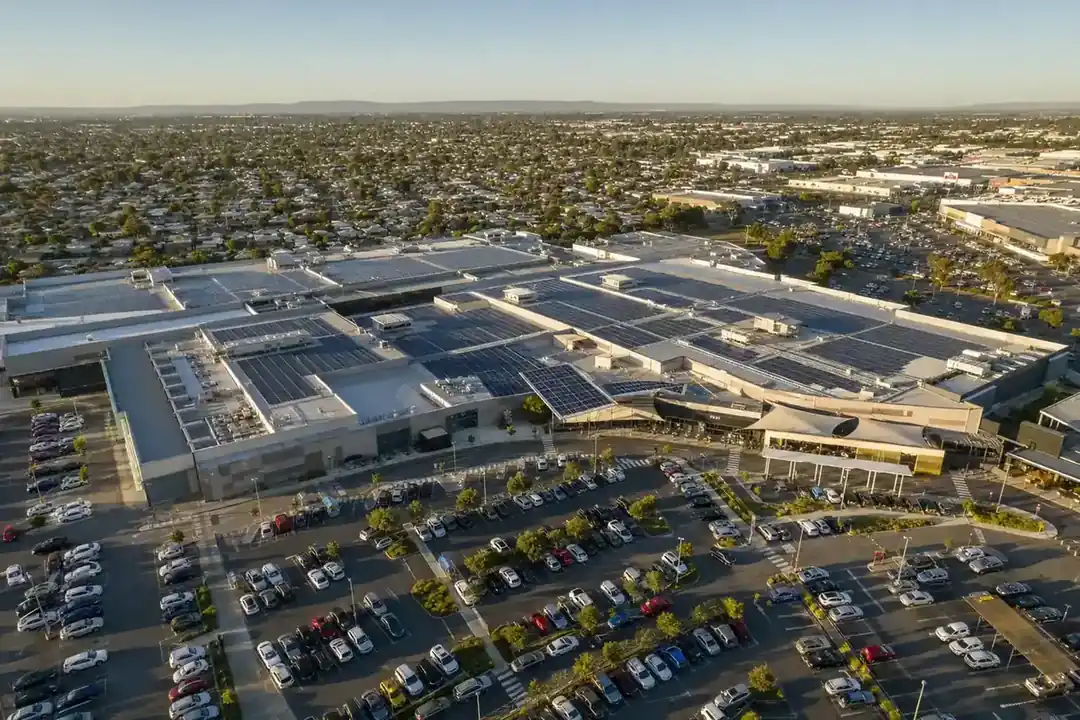
Commercial Solar for Adelaide Retail
SA retail and shopping centre loads - lighting, HVAC, escalators, and common area plant - concentrate during trading hours. That alignment with solar generation produces strong on-site consumption and a measurable reduction in energy spend.
 4.9Google rating328 reviews
The load profile
Why solar fits retail & shopping centres
Retail buildings and shopping centres in South Australia carry high, consistent energy loads across trading hours. Lighting, air conditioning, escalators, refrigerated display cases, and common area plant all draw during the same window that solar generation is available - producing one of the more reliable self-consumption ratios in commercial solar.
SA's commercial electricity tariffs make that self-consumption particularly valuable. For a large SA shopping centre spending $500,000-$2,000,000 per year on electricity, a reduction of even 20-30% in daytime grid consumption represents a material improvement in operating cost.

Trading Hours Load Alignment
Retail load - lighting, HVAC, escalators, POS systems, and food court kitchen equipment - concentrates between 9am and 6pm, directly overlapping with the SA solar generation window.

HVAC Dominates the Energy Bill
Air conditioning typically accounts for 40-60% of a shopping centre's total electricity spend. SA summer heat amplifies this load while solar output is at its seasonal peak, improving the offset rate during the most expensive operating period.

Common Area vs Tenancy Load Split
The centre landlord controls common area load (HVAC plant, car park lighting, escalators, management office). Tenant energy is separately metered. Solar can be structured to offset common area load, tenancy load, or both through virtual net metering.
The numbers
Commercial solar economics for retail & shopping centres
Suitability depends on lease structures, tenant agreements, and network tariff arrangements. We model all applicable structures in the feasibility.
| Solar Structure | Who Benefits | Complexity | Best For |
|---|---|---|---|
| Common area offset only | Landlord - reduction in outgoings | Low - single meter connection | Landlords seeking direct operating cost reduction |
| Virtual net metering | Landlord and nominated tenants | Medium - network agreement required | Centres with anchor tenants willing to participate |
| Embedded network | All tenants and common areas | High - network operator licence required | Large centres or new developments seeking full energy control |
| Tenant direct (rooftop licence) | Individual anchor tenant | Low-Medium - bilateral agreement | Major anchor tenants with high energy spend |
Indicative figures. Your written proposal models your exact site.
Why it matters
A generic install leaves money on the roof
For a retail & shopping centres site, the difference between a catalogue system and a load-matched one is years off your payback.
A generic installer
- Sized to your roof area, not your actual load
- Priced per kW off a catalogue
- One-size panel + inverter bundle
- Demand charges ignored
- Handed off the day it's switched on
Our load-matched approach
- Sized to your real interval data
- Costed line by line for your site
- Panels + inverter matched to your load profile
- Battery + design target peak-demand charges
- Monitored and serviced by the same team
Solar built for retail & shopping centres?
Get a free quote. We model the system, savings and payback before you commit to anything.
How we'd approach your site
From power bill to payback
 01
01Load analysis
We pull your interval data and map exactly how and when the site draws power.
 02
02System design
Array, inverter and battery sized to that load, modelled for real generation and self-consumption.
 03
03CEC install
Licensed, insured, in-house installation to SA grid rules, planned around your operating hours to keep disruption to a minimum.
04Monitor & service
Live performance monitoring so the return you were quoted is the return you keep.
What we deliver
Services for retail & shopping centres

Commercial Solar Panels & Systems
Engineered rooftop PV from 30kW to 1MW+, sized to your load profile.
Learn more
Solar PPA & Financing
Zero-upfront power purchase agreements and finance that cash-flows from day one.
Learn moreEnergy Audits & Feasibility
Load analysis and ROI modelling before a single panel is ordered.
Learn moreIn detail
Solar for retail & shopping centres, in detail
A shopping centre is an energy-intensive building type. The combination of large HVAC plant, high-intensity retail lighting across large floor areas, food court kitchen equipment, escalators, refrigerated display cases in supermarkets and food retailers, and common area services creates a consistent, high electricity draw from opening to close.
For most SA retail properties, that load runs from 7am (pre-opening building conditioning) to 7-9pm (close plus post-trade cleanup). The overlap with solar generation - typically 7am to 5pm in SA - covers a large proportion of the trading day and the highest-load portion of it.
Summer Trading Is the Best Solar Period
SA summer brings the highest retail foot traffic, the longest trading hours, and the highest HVAC load - all at the time of year when solar panels generate most. For a shopping centre, this means the energy cost reduction from solar is greatest during the months when the total bill is highest. That is the ideal solar economic scenario.
Large shopping centres often have car park structures adjacent to the main building with flat roof areas that can support solar arrays. Ground-mounted canopy systems over open car parks are also available. We assess all available surface area - not just the main roof - to maximise total generation capacity for the site.
Common Area Solar vs Tenant Distribution
The most straightforward retail solar structure connects generation directly to the landlord's common area meter, offsetting the electricity costs the landlord controls - HVAC plant, car park lighting, escalators, management office, and common mall areas. This structure is simple, requires no tenant agreement, and delivers a direct reduction in outgoings.
A more comprehensive structure distributes solar generation across tenant meters using virtual net metering or an embedded network. This allows tenants to benefit directly from the rooftop solar, which can improve the centre's competitive position for attracting and retaining tenants seeking to reduce their own operating costs.
Lease and Heads of Agreement Considerations
Retail lease structures can affect solar project feasibility where a tenant lease includes provisions over the building roof or the electricity supply arrangement. We review relevant lease provisions as part of the project assessment and identify any constraints before the design is finalised.
Retail solar sizing is driven by available roof area, self-consumption rate, and any network export limit imposed by SA Power Networks. For large shopping centres with constrained export capacity, battery storage can be added to capture surplus generation that would otherwise be curtailed.
- Small neighbourhood centre (3,000-8,000 sqm GFA): 50kW - 200kW system typical
- Medium sub-regional centre (8,000-30,000 sqm GFA): 200kW - 800kW system typical
- Large regional centre (30,000+ sqm GFA): 800kW - 3MW+ depending on roof and load
- Open air car park canopy: additional generation capacity on unused horizontal surfaces
- Battery storage: available for all sizes where export limits or evening peak reduction is a priority
Larger shopping centres connect to the SA Power Networks network at high-voltage points where export limits may apply. We investigate the connection point parameters early in the project and design the system to operate within those limits, using battery storage where needed to avoid generation curtailment.
Every retail solar project we design includes a detailed assessment of existing roof penetrations, HVAC plant locations, and weight loading across the roof structure. Shopping centre roofs are often more complex than industrial roofs, and accurate roof mapping is essential to maximise panel placement without conflict with existing plant.
NABERS Energy Ratings and Solar
Solar generation feeds into NABERS Energy ratings for commercial buildings by reducing the net electricity drawn from the grid. For shopping centres seeking to improve their NABERS rating - a metric increasingly used by anchor tenants in lease negotiations - a documented solar generation figure is a straightforward way to improve measured energy performance.
Our monitoring platform generates the generation data in a format compatible with NABERS Energy and Green Star submissions, and can produce the annual Greenhouse and Energy Minimum Standards (GEMS) reporting data required for larger centres.
A commercial roof is a balance sheet asset. For retail landlords, that asset generates both direct energy cost savings and sustainability credentials that matter to anchor tenants.
Commercial Solar Adelaide
We install commercial solar on retail properties across Adelaide's metropolitan area and on regional SA shopping centres and large-format retail facilities.
- Inner-metro retail strips and neighbourhood centres - Unley, Norwood, Glenelg, Prospect
- Northern suburbs centres - Elizabeth, Salisbury, Tea Tree Gully, Golden Grove
- Western suburbs retail - Port Adelaide, Semaphore, West Lakes, Henley Beach
- Southern suburbs centres - Noarlunga, Christies Beach, Morphett Vale, Marion
- Adelaide Hills and regional SA centres - Mount Barker, Murray Bridge, Whyalla, Port Augusta
- Large-format retail precincts - homemaker centres, bulky goods, trade retail parks
Commercial solar on retail properties requires coordination with centre management, tenants, and where applicable the building owner. We manage that coordination and provide the documentation that property managers and strata bodies require for project approval.
Next step
Model the numbers for your retail & shopping centres site
Send us your site details and recent power bills. We'll size a system to your load and show the savings and payback, at no cost.
- Free feasibility assessment
- Sized to your load profile
- Transparent payback
Free quote
Want the numbers for your site?
We model system size, savings and payback before you commit to anything.
(08) 7093 6389FAQ
Frequently asked questions
For a centre trading from 9am to 6pm, solar generation covers a large portion of that trading window. A well-sized system can offset 20-40% of a centre's total annual electricity consumption, with a higher offset rate during summer when solar output and HVAC load both peak together. The exact figure depends on roof area, load profile, and system size.
The simplest structure offsets the landlord's common area load with no impact on tenant metering. Where you want tenants to benefit from the solar, virtual net metering can distribute credits across tenant meters - but this requires a network agreement and may interact with existing lease electricity provisions. We review your lease structure before recommending a solar distribution model.
Roof mapping is the first step in any retail solar assessment. We survey the roof, identify all existing plant, penetrations, walkways, and access requirements, and design the panel layout around those constraints. Car park structures and canopy options are also assessed if the main roof has limited available area.
Yes. Solar generation reduces the net electricity drawn from the grid, which is the primary input to a NABERS Energy rating calculation. A documented solar generation figure from a calibrated monitoring system provides the verifiable data NABERS requires for a certified rating.
Indicative payback ranges from 5-8 years for most SA shopping centres, depending on electricity tariff rates, system size, roof area, and on-site consumption rate. Centres with higher C&I tariff rates and strong daytime foot traffic tend toward the shorter end of that range. We produce a 25-year discounted cash flow as part of the feasibility assessment.
Start with the numbers, not a sales pitch.
Book a free feasibility assessment and we will model the system, savings and payback for your site before you commit to anything.