
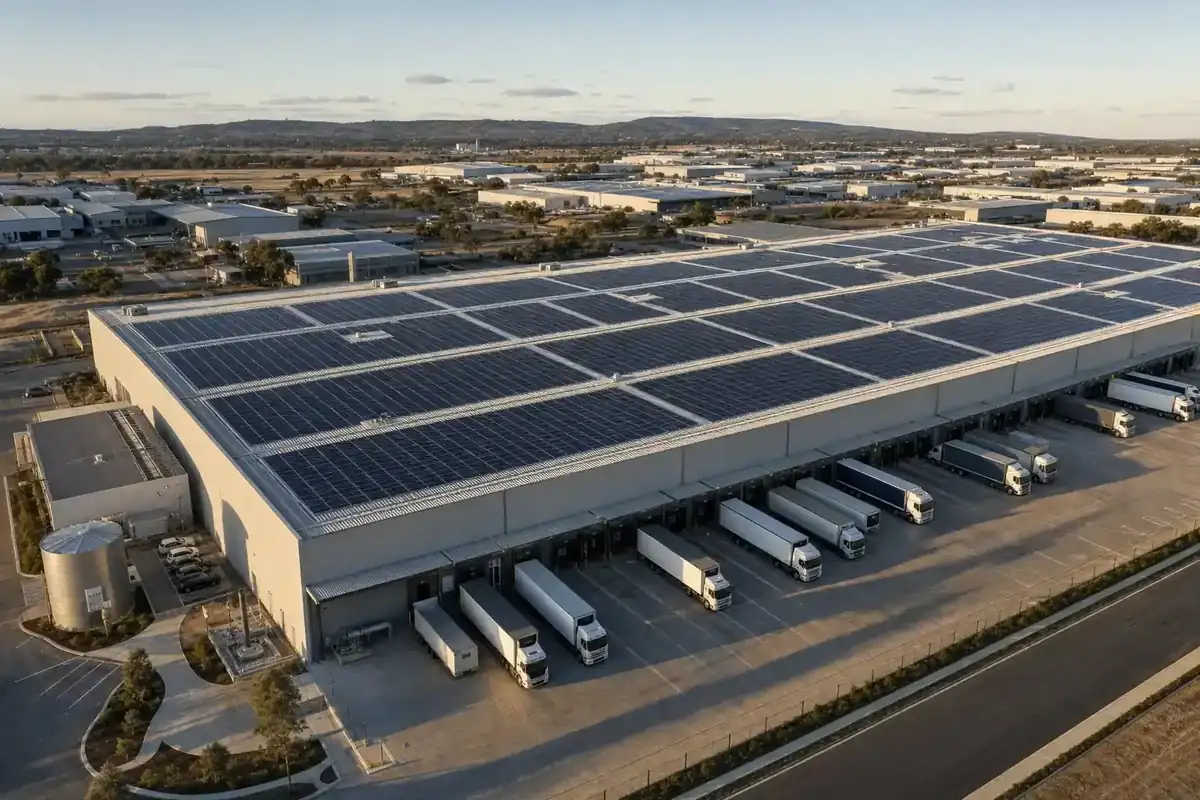
Commercial Solar for Adelaide Warehousing
Distribution centres and logistics hubs carry high daytime electricity loads across large flat roofs. That combination produces some of the most straightforward solar economics in the SA commercial market.
 4.9Google rating328 reviews
The load profile
Why solar fits warehousing & logistics
Warehousing and logistics facilities have two characteristics that make commercial solar particularly compelling: large flat roof areas that can support high-density panel arrays, and daytime operations that concentrate electricity consumption during solar generation hours.
Pick-and-pack operations, loading dock equipment, lighting across large floor areas, HVAC systems, and office loads all draw during standard operating hours. That load - running from early morning to late afternoon - aligns closely with the SA solar generation window and produces strong on-site consumption rates.

Large Flat Roof Capacity
Standard distribution centre roof spans of 5,000-20,000 sqm can accommodate arrays of 500kW to 2MW+, with minimal shading from adjacent structures in most Adelaide industrial estates.

Daytime Operations Alignment
Warehouse operations - pick-and-pack, dock loading, lighting, HVAC - concentrate load during 6am-6pm shifts, which matches the SA solar generation window almost exactly.

Lighting Load is Solar-Friendly
High-bay LED lighting across large warehouse floors is a consistent, predictable load. Unlike motor-driven plant with demand spikes, lighting load is steady and easy to offset with solar generation.
The numbers
Commercial solar economics for warehousing & logistics
Indicative figures only. Actual system size is determined by on-site load analysis, roof structural capacity, and SA Power Networks connection parameters.
| Distribution Centre Size | Roof Area (indicative) | Typical Solar System | Est. Annual Generation |
|---|---|---|---|
| Small warehouse (under 3,000 sqm GFA) | 2,000 - 4,000 sqm roof | 100kW - 200kW | 150,000 - 300,000 kWh |
| Medium DC (3,000-8,000 sqm GFA) | 4,000 - 10,000 sqm roof | 200kW - 600kW | 300,000 - 900,000 kWh |
| Large DC (8,000-20,000 sqm GFA) | 10,000 - 22,000 sqm roof | 600kW - 1.5MW | 900,000 - 2,200,000 kWh |
| Major logistics hub (20,000+ sqm GFA) | 22,000+ sqm roof | 1.5MW - 5MW+ | 2,200,000+ kWh |
Indicative figures. Your written proposal models your exact site.
Why it matters
A generic install leaves money on the roof
For a warehousing & logistics site, the difference between a catalogue system and a load-matched one is years off your payback.
A generic installer
- Sized to your roof area, not your actual load
- Priced per kW off a catalogue
- One-size panel + inverter bundle
- Demand charges ignored
- Handed off the day it's switched on
Our load-matched approach
- Sized to your real interval data
- Costed line by line for your site
- Panels + inverter matched to your load profile
- Battery + design target peak-demand charges
- Monitored and serviced by the same team
Solar built for warehousing & logistics?
Get a free quote. We model the system, savings and payback before you commit to anything.
How we'd approach your site
From power bill to payback
 01
01Load analysis
We pull your interval data and map exactly how and when the site draws power.
 02
02System design
Array, inverter and battery sized to that load, modelled for real generation and self-consumption.
 03
03CEC install
Licensed, insured, in-house installation to SA grid rules, planned around your operating hours to keep disruption to a minimum.
04Monitor & service
Live performance monitoring so the return you were quoted is the return you keep.
What we deliver
Services for warehousing & logistics

Commercial Solar Panels & Systems
Engineered rooftop PV from 30kW to 1MW+, sized to your load profile.
Learn more
Commercial EV Charging
Solar-backed EV charging for fleets, staff and customer car parks.
Learn moreSolar Monitoring & Maintenance
Live performance monitoring and servicing to protect your return.
Learn moreIn detail
Solar for warehousing & logistics, in detail
The fundamental requirement for strong commercial solar economics is a large on-site load that runs during daylight hours. Warehousing and logistics facilities satisfy both conditions more reliably than almost any other sector.
A 10,000 sqm distribution centre can support a solar system of 500kW to 1MW on its roof. At current SA electricity tariffs, that system generates $120,000-$250,000 worth of electricity per year at indicative self-consumption rates. The roof area that was previously a maintenance cost becomes a revenue-generating asset.
The Role of Lighting Load in Warehouse Solar
High-bay LED lighting is one of the most solar-compatible loads in a warehouse. Unlike compressors or manufacturing plant that cycle and spike, LED lighting draws a flat, predictable load across all operating hours. A 10,000 sqm warehouse with LED high-bays can draw 40-80kW of lighting load alone during the working day - a significant and consistent solar consumption target.
If your facility has multiple tenants with separate electricity meters, virtual net metering or shared solar arrangements allow the generation from one rooftop array to be credited across multiple accounts. We design these structures and manage the relevant network agreements with SA Power Networks.
From Roof Survey to Generation Model
Warehouse roofs present some of the cleanest solar installation conditions in the commercial market - large flat spans, minimal shading from adjacent structures in most Adelaide industrial estates, and simple grid connection at the main switchboard. The main design variables are self-consumption rate and any network export limit.
Network Export Limits and How We Work Around Them
SA Power Networks may impose export limits on large systems to protect grid stability in some industrial precincts. Where an export limit applies, we design the system to maximise on-site consumption first, and incorporate battery storage to capture surplus generation that would otherwise be curtailed.
In practice, most large warehousing facilities have high enough daytime load that an appropriately sized system operates well within export limits without requiring storage. The load analysis confirms this before any design decision is made.
Logistics and warehousing operations are accelerating the transition to electric forklifts, electric pallet movers, and light commercial electric vehicles. Solar generation provides a natural, low-cost fuel source for these fleets when charging is scheduled during operating hours.
- Electric forklifts charged during solar hours consume generation that would otherwise be exported at low feed-in tariff rates
- Fleet vehicle charging at workplace charging points reduces overnight grid energy draw
- Solar-backed EV charging reduces overall fleet fuel and energy costs in one system
- SAPN-approved charging infrastructure integrates with the solar inverter and monitoring platform
- We design EV charging load into the solar system sizing from the outset, not as a retrofit
If you are planning to transition to electric forklifts or light commercial vehicles over the next 3-5 years, tell us at the design stage. Sizing the solar system to accommodate that future load now avoids an undersized system that cannot support your full energy requirements later.
Adelaide's logistics and warehousing sector is concentrated in the northern and western industrial precincts, with growing distribution activity in the southern suburbs around Lonsdale and along the South Road corridor.
- Wingfield and Gepps Cross - major 3PL, freight, and cold chain logistics hubs
- Regency Park and Mansfield Park - retail distribution and manufacturing warehousing
- Edinburgh North and Direk - defence logistics, aerospace, and large-format distribution
- Gillman and Dry Creek - bulk goods, chemical storage, and heavy freight handling
- Lonsdale and Morphett Vale - southern logistics and construction supply warehousing
- Tonsley and Edwardstown - advanced manufacturing and high-value goods storage
We also install commercial solar on logistics and warehousing facilities in regional SA, including major distribution centres in Mount Barker, Murray Bridge, Port Pirie, and Port Augusta.
Performance Visibility Across a Large Array
A 500kW to 1MW rooftop array contains 1,000-2,500 individual solar panels. String-level and inverter-level monitoring identifies underperforming sections of the array before they degrade overall system output in a way that is invisible on a simple generation meter.
Our monitoring platform tracks generation output against expected performance, sends alerts when output deviates from the model, and provides the data your finance team needs for depreciation and asset reporting. Quarterly performance reports are included as standard.
Payback in years, savings for decades. Live monitoring is how you protect the decades part of that equation.
Commercial Solar Adelaide
Next step
Model the numbers for your warehousing & logistics site
Send us your site details and recent power bills. We'll size a system to your load and show the savings and payback, at no cost.
- Free feasibility assessment
- Sized to your load profile
- Transparent payback
Free quote
Want the numbers for your site?
We model system size, savings and payback before you commit to anything.
(08) 7093 6389FAQ
Frequently asked questions
A 10,000 sqm roof can support a system of 600kW to 1MW depending on roof structural capacity, panel layout, and any shading from skylights or roof plant. At current SA tariff rates, a 800kW system generates an estimated $180,000-$220,000 worth of electricity per year at indicative self-consumption rates. We confirm exact sizing after a roof survey and load analysis.
Export limits can apply in some industrial precincts where the network is already heavily loaded. Where a limit applies, we design the system to maximise on-site consumption and incorporate battery storage to capture surplus that would otherwise be curtailed. We liaise with SA Power Networks on your behalf during the connection application process.
Yes. Virtual net metering or shared solar structures allow generation from one rooftop array to be credited across multiple electricity accounts. We design these arrangements and manage the network agreements required. The feasibility model shows the bill impact for each tenant meter.
Electric forklift charging scheduled during solar hours consumes generation that would otherwise be exported at low feed-in tariff rates. We include planned forklift charging load in the solar system sizing from the outset, ensuring the system is sized to cover both your building load and your fleet charging requirement.
A vacant warehouse with no load will export generation to the grid at the applicable feed-in tariff rate. That rate is lower than the avoided cost of grid electricity, which reduces your return during vacancy. We model realistic occupancy assumptions in the feasibility so you understand the impact of a vacancy period on your projected payback.
Start with the numbers, not a sales pitch.
Book a free feasibility assessment and we will model the system, savings and payback for your site before you commit to anything.