
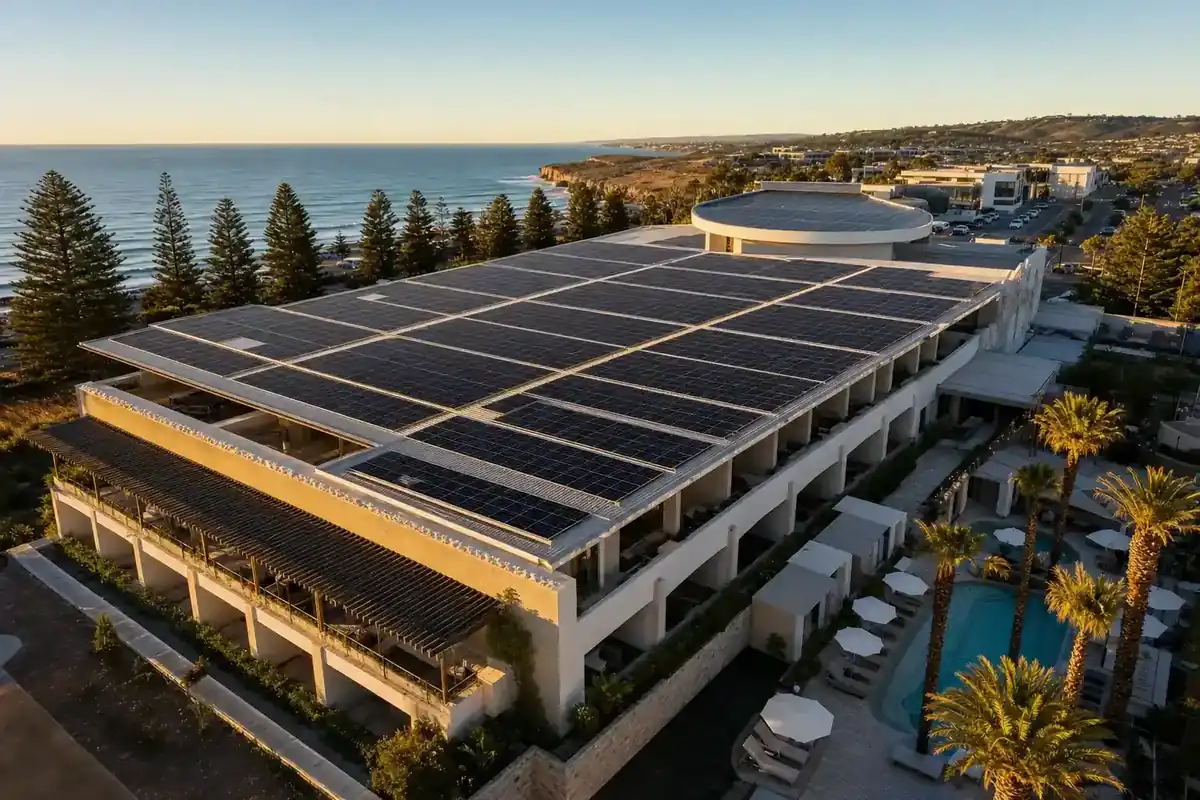
Commercial Solar for Adelaide Hospitality
SA hotels, resorts, restaurants, and function venues carry high energy loads across kitchens, HVAC, laundry, and guest facilities. We engineer solar systems around your operating load, not a standard commercial template.
 4.9Google rating328 reviews
The load profile
Why solar fits hospitality & tourism
Hospitality properties in South Australia operate across a broader daily window than most commercial buildings. Kitchens run from early morning food preparation through to post-trade cleaning. HVAC systems condition guest areas, dining rooms, function spaces, and back-of-house areas across multiple shifts. Commercial laundry equipment draws heavily during morning linen turnaround.
That spread of load across the day - with significant concentration during solar generation hours - creates genuine solar economics for hotels, resorts, restaurants, and function venues. The portion of load that falls in the evening peak (4pm-9pm) is where battery storage extends the benefit beyond what solar generation alone can deliver.

Kitchen and Catering Load During Solar Hours
Commercial kitchen equipment - ovens, combi steamers, refrigeration, dishwashers, and ventilation - draws heavily from early morning through to mid-afternoon service, directly within the solar generation window.

Guest HVAC Across Accommodation
SA summer guest HVAC load peaks when solar output is highest. For coastal and Hills resorts, summer is the peak season - so the highest energy demand and the highest solar generation coincide.

Commercial Laundry in the Morning Window
Linen and towel laundering for hotel accommodation concentrates in the 6am-11am window as room turnaround begins. That load is directly capturable by solar generation with no storage required.
The numbers
Commercial solar economics for hospitality & tourism
Indicative shares. Actual distribution varies significantly by property type, age, and operating model.
| Load Category | Typical Share of Energy Bill | Solar Window Alignment | Battery Storage Benefit |
|---|---|---|---|
| HVAC (guest areas, function spaces) | 35-45% | High - peaks during summer daylight hours | Moderate - some evening load |
| Commercial kitchen and catering | 15-25% | High - most meal prep is daytime | Low - evening dinner service is the gap |
| Commercial laundry | 10-15% | Excellent - concentrated in morning solar window | Not usually required |
| Hot water systems | 8-12% | Good - daytime heating cycles align with solar | Low - off-peak electric HWS reduces evening load |
| Lighting (common areas, car parks) | 8-12% | Moderate - day areas solar; night areas not | Moderate for peak tariff overlap |
| Pool, spa, and recreation | 5-10% | Good - daytime filtration and heating align | Low |
Indicative figures. Your written proposal models your exact site.
Why it matters
A generic install leaves money on the roof
For a hospitality & tourism site, the difference between a catalogue system and a load-matched one is years off your payback.
A generic installer
- Sized to your roof area, not your actual load
- Priced per kW off a catalogue
- One-size panel + inverter bundle
- Demand charges ignored
- Handed off the day it's switched on
Our load-matched approach
- Sized to your real interval data
- Costed line by line for your site
- Panels + inverter matched to your load profile
- Battery + design target peak-demand charges
- Monitored and serviced by the same team
Solar built for hospitality & tourism?
Get a free quote. We model the system, savings and payback before you commit to anything.
How we'd approach your site
From power bill to payback
 01
01Load analysis
We pull your interval data and map exactly how and when the site draws power.
 02
02System design
Array, inverter and battery sized to that load, modelled for real generation and self-consumption.
 03
03CEC install
Licensed, insured, in-house installation to SA grid rules, planned around your operating hours to keep disruption to a minimum.
04Monitor & service
Live performance monitoring so the return you were quoted is the return you keep.
What we deliver
Services for hospitality & tourism

Commercial Solar Panels & Systems
Engineered rooftop PV from 30kW to 1MW+, sized to your load profile.
Learn more
Solar PPA & Financing
Zero-upfront power purchase agreements and finance that cash-flows from day one.
Learn more
Commercial EV Charging
Solar-backed EV charging for fleets, staff and customer car parks.
Learn moreIn detail
Solar for hospitality & tourism, in detail
Hotel and resort energy spend is spread across more categories than most commercial building types. HVAC, hot water, kitchen, laundry, lighting, pool and spa heating, car park, and guest room power all contribute. Understanding which of those loads run during solar generation hours determines how much of the total bill solar can directly address.
The Evening Load Challenge
Hospitality solar economics are strong for the daytime loads - kitchen, laundry, HVAC during operational hours, pool plant. The challenge is the evening peak, when restaurants, bars, and guest room demand continues but solar generation has ceased. Battery storage addresses this gap by storing surplus daytime generation for discharge during the 4pm-9pm peak tariff window.
Peak summer in South Australia is both the highest-occupancy period for many hospitality properties and the highest solar generation period of the year. HVAC runs hardest, guests use pool and outdoor facilities, and breakfast and lunch service is extended. The electricity bill peak and the solar generation peak arrive together - which is why SA hospitality solar economics are compelling.
Property Type Shapes the Design
A boutique accommodation property in the Adelaide Hills has a very different energy profile from a 200-room metropolitan hotel or a large function and conference centre. We design around the specific operating pattern, occupancy profile, and roof area of each property.
Battery Storage for Evening Peak Load
We recommend battery storage for most hospitality solar projects where the property carries significant evening load - restaurants, function venues, bars, and hotels with extended evening trading. The battery is sized to the gap between when solar generation ceases (around 5-6pm in summer) and when the highest-cost tariff period ends (around 9pm on most SA C&I tariffs).
The addition of battery storage typically extends the indicative payback period by 1-2 years but produces a materially better energy cost reduction across the full operating day. For properties with significant evening trading, the storage investment is justified by the demand charge reduction and peak tariff offset it delivers.
We install commercial solar on hospitality properties across Adelaide's metropolitan area and the SA tourism regions, including the wine country, coastal destinations, and outback tourism facilities.
- Adelaide CBD and inner suburbs - hotels, restaurants, function centres, and licensed venues
- Glenelg and Adelaide's beachside suburbs - coastal accommodation, hotels, and seafood restaurants
- Barossa Valley - boutique accommodation, cellar door restaurants, and resort-style lodges
- Adelaide Hills - Mount Barker, Hahndorf, and Hills accommodation and restaurant properties
- McLaren Vale and Fleurieu Peninsula - winery restaurants, boutique accommodation, and resort properties
- Kangaroo Island - lodges, eco-accommodation, and island hospitality operations
- Victor Harbor and Encounter Bay - coastal accommodation and function venues
- Clare Valley and Riverland - winery accommodation and regional hospitality
Many SA hospitality properties occupy heritage-listed or character buildings where rooftop solar requires planning consideration. We have experience working through the SA Heritage Council approval process and designing systems that respect the character of the building while maximising generation from available roof areas.
Solar Is Visible Evidence of Energy Credentials
SA tourism operators increasingly report that guests - particularly international visitors from European markets - ask about sustainability practices at the point of booking. A documented solar installation with verifiable generation data provides a concrete sustainability credential that is more credible than a broad environmental claim.
We provide generation reporting in formats suitable for tourism and hospitality sustainability certification bodies, including EarthCheck and SA Tourism's own accreditation framework. The monitoring data is the asset; we just help you present it clearly.
Design, install and finance under one roof. For hospitality operators, that means the feasibility model, the installation timeline, and the monitoring platform all come from one accountable partner.
Commercial Solar Adelaide
EV charging for guests is a growing request from SA hospitality guests. Solar-backed EV charging infrastructure installed alongside the solar system provides a genuine service differentiator for properties targeting the premium leisure and corporate travel market. We design solar, storage, and EV charging as an integrated system rather than three separate installations.
Finance Options for Hospitality Property Owners
Hospitality property owners face a range of financing choices depending on whether the property is owner-occupied or investment, and whether the solar project is being funded from property or operating capital.
- Outright purchase - maximum long-term return, full depreciation, immediate ownership of certificates
- Commercial loan - typically 5-7 year term, repayments below monthly energy savings for most SA hospitality properties
- Power Purchase Agreement - zero capital outlay, fixed solar tariff rate below grid cost, no maintenance responsibility
- Chattel mortgage or finance lease - structured finance options suitable for hospitality businesses with existing property debt
- Green finance products - several SA banks offer reduced-rate finance for commercial solar as part of sustainability-linked lending programmes
For hospitality operators in the SA wine regions, the clean energy investment thesis has been well-established by comparable cellar door and resort operations that have completed commercial solar projects. We can provide references to comparable SA hospitality solar projects - without fabricating case studies - so you can speak with operators who have been through the process.
Next step
Model the numbers for your hospitality & tourism site
Send us your site details and recent power bills. We'll size a system to your load and show the savings and payback, at no cost.
- Free feasibility assessment
- Sized to your load profile
- Transparent payback
Free quote
Want the numbers for your site?
We model system size, savings and payback before you commit to anything.
(08) 7093 6389FAQ
Frequently asked questions
For most SA hotels with standard operating hours, solar can offset 25-45% of total annual electricity consumption. The exact figure depends on roof area, system size, and how much of the property's load runs during solar generation hours. Evening load - restaurants, bars, and guest room demand after 5pm - falls outside the solar window unless battery storage is added.
For properties with significant evening trading - restaurants, function venues, bars - battery storage delivers a material improvement in energy cost reduction by covering the 4pm-9pm peak tariff window when solar generation has stopped but demand is high. The payback on storage alone is typically 6-9 years, but the combined solar plus storage return is usually the better investment decision for hospitality properties with evening operations.
Heritage listing does not automatically prevent solar installation, but it does require a considered approach to design and placement. We have experience working through the SA Heritage Council and Development Approval processes for listed properties, and designing systems that comply with heritage conditions while maximising generation from available roof areas.
Yes. Solar-backed EV charging is a natural complement to hospitality solar. We design solar, battery storage, and EV charging infrastructure as an integrated system rather than three separate installations. The solar system is sized to cover both building load and projected EV charging demand from the outset.
Our monitoring platform records generation data in formats compatible with common sustainability reporting frameworks including EarthCheck, the SA Tourism sustainability accreditation programme, and NABERS Energy. The data is verifiable and time-stamped, which makes it more credible for third-party accreditation review than an estimated or calculated figure.
Start with the numbers, not a sales pitch.
Book a free feasibility assessment and we will model the system, savings and payback for your site before you commit to anything.