
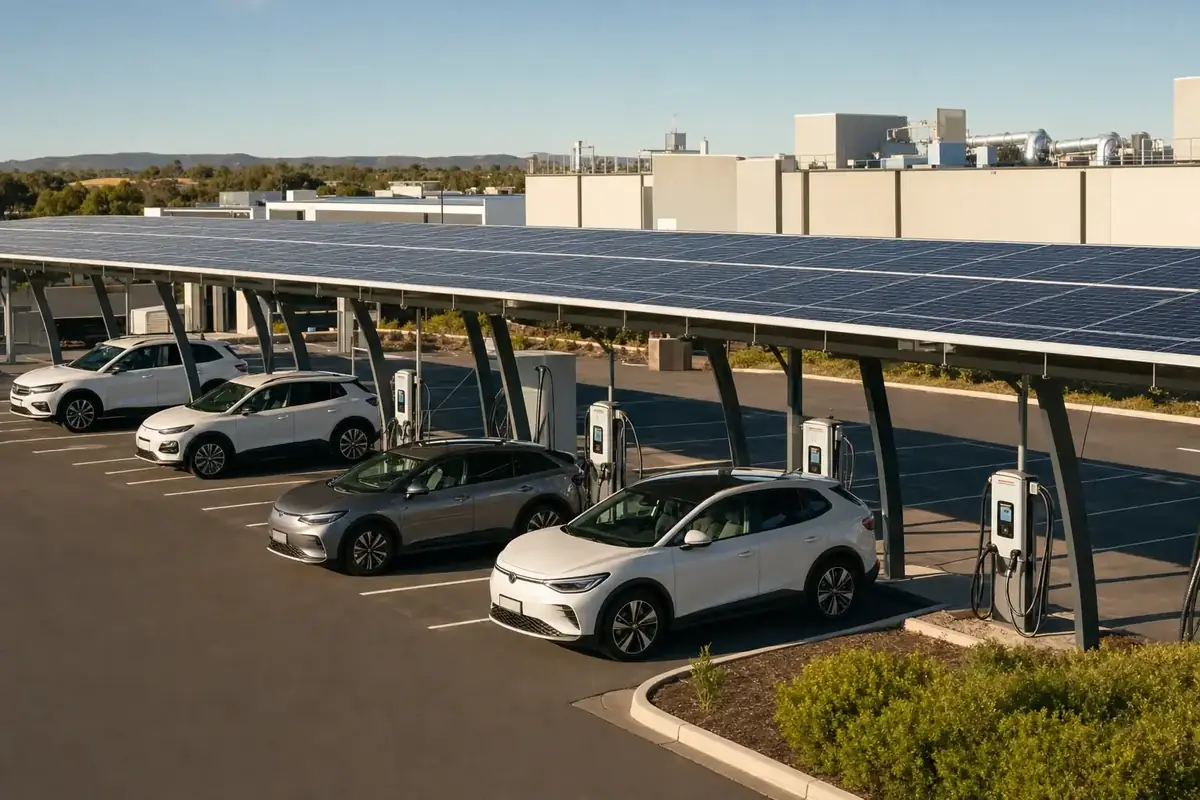
Commercial EV Charging Stations in Adelaide
Solar-backed EV charging for Adelaide fleets, staff car parks and customer facilities - designed so the sun charges the cars.
 4.9Google rating328 reviews
Why it pays
The case for commercial ev charging

Solar-backed charging reduces operating cost
Pairing EV chargers with rooftop solar cuts the effective cost of charging to the cost of the solar system, not the grid import tariff. For fleets with predictable daytime routes, this is a strong ROI argument.

Smart load management protects your demand charge
Without load management, multiple EV chargers starting simultaneously can create a large demand spike. Our smart charging platforms manage charge rates dynamically to protect your demand charge.

Scalable from one charger to a full depot
We design EV charging infrastructure to scale. A single distribution board with spare capacity now avoids expensive electrical upgrades when the fleet grows.
The numbers
What to expect
Indicative Adelaide installed costs including board works and cabling. Actual costs depend on distance from switchboard, cable size, trenching requirements and quantity. All pricing indicative only.
| Charger Type | Output | Charge Time (50kWh battery) | Best Application | Indicative Cost Installed |
|---|---|---|---|---|
| AC Level 2 (7kW) | 7kW | 7-8 hours | Overnight staff or fleet depot | $3,000-$6,000 per point |
| AC Level 2 (22kW) | 22kW | 2.5-3 hours | Daytime workplace, retail dwell | $5,000-$10,000 per point |
| DC Fast Charge (50kW) | 50kW | 60-90 min | Fleet changeover, customer use | $25,000-$45,000 |
| DC Fast Charge (150kW) | 150kW | 20-30 min | High-throughput public or fleet | $65,000-$120,000 |
| DC Ultra-fast (200kW+) | 200kW+ | Under 20 min | Highway, large depot, truck fleet | Project-specific quote |
Indicative figures. Your written proposal models your exact site.
Why it matters
Engineered for your site, not off the shelf
The system that pays back fastest is the one built around how you actually use power, not a bundle off a price list.
Off-the-shelf install
- A kW figure straight off a price list
- A standard panel + inverter bundle
- Roof filled regardless of your load
- Export you barely get paid for
- Installed, then forgotten
Our engineered approach
- Sized to your actual power bills
- Panels + inverter matched to your site
- Built to maximise self-consumption
- Battery + design to cut peak-demand charges
- Monitored and serviced by our own team
Thinking about commercial ev charging?
Get a free quote. We model the system, savings and payback before you commit to anything.
How we work
A clear path from enquiry to switch-on
Site load monitoring
A CT sensor or smart meter monitors total site demand in real time and feeds data to the EV management system.
Dynamic power allocation
The system distributes available power across active chargers based on vehicle state of charge, user priority settings and solar generation availability.
Solar priority mode
When the site is generating surplus solar, the management system directs that energy to vehicle charging first, ahead of grid export.
Demand cap enforcement
A configurable demand cap prevents total site draw from exceeding the threshold that would trigger a demand charge penalty.
Adelaide & South Australia
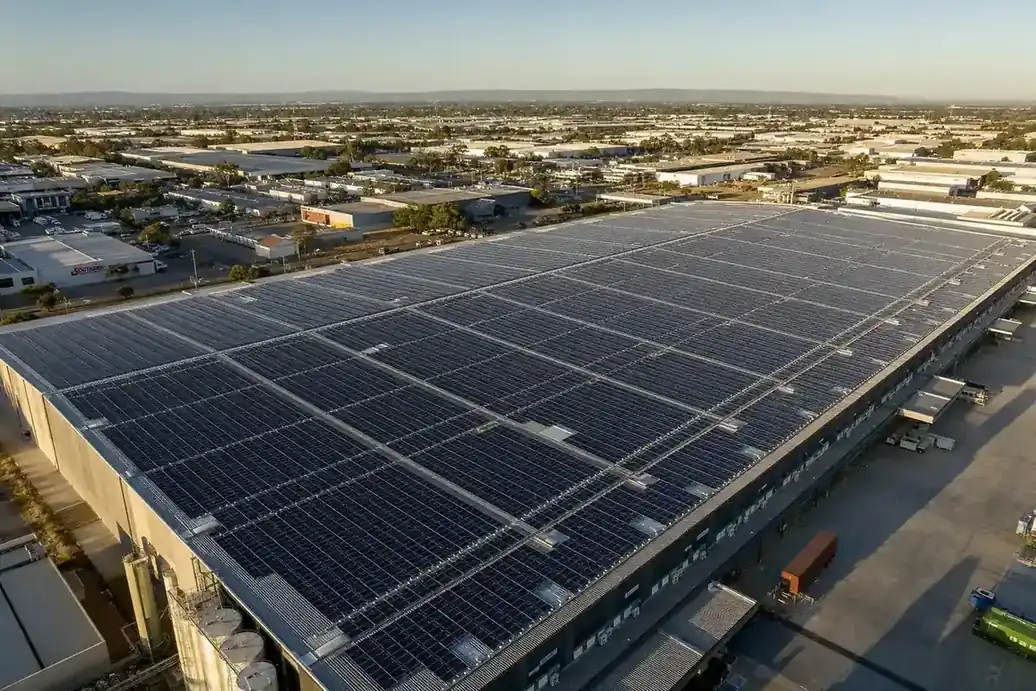
A commercial roof is a balance-sheet asset
Put the sun on your roof to work. We design, install and finance systems that pay for themselves and keep saving for decades.
End to end
Everything included, under one roof
In detail
The detail that matters
An Adelaide business running a 10-vehicle light commercial fleet covers roughly 100,000-150,000 km per year. At average EV consumption of 0.18-0.25 kWh/km, that fleet needs 18,000-37,500 kWh per year to charge. At grid rates of $0.28-$0.35 per kWh that is $5,000-$13,000 per year in charging energy costs.
If that same fleet charges predominantly from a solar system already on the business roof, the marginal cost of charging drops toward the cost of the solar asset amortised over its life. The operational saving relative to grid charging is material, and the saving relative to the equivalent petrol or diesel fuel cost is even larger.
AC chargers are limited by the onboard charger in the vehicle. Most light passenger EVs accept 7-11kW AC. Commercial vans and SUVs vary between 7-22kW AC. DC fast chargers bypass the onboard charger and charge directly to the battery, delivering much faster rates. Fleet charger selection must be matched to the vehicles in the fleet, not just the installation budget.
Why unmanaged EV charging creates a demand problem
A car park with 10 unmanaged 22kW chargers creates a potential 220kW demand load. If vehicles return and begin charging simultaneously after a shift change, all 10 chargers ramp to full output at the same time. On a demand tariff with a $15-$25 per kW demand charge, that 30-minute spike adds $3,300-$5,500 to the monthly bill.
How smart charging resolves the problem
A smart charging management system monitors total site demand in real time and dynamically limits individual charger output to keep total demand below a set threshold. Vehicles charge at the available rate, completing a full charge within the parking window. No driver experiences a failed charge; the meter never sees the spike.
Payback in years, savings for decades. The fleet that charges on its own solar roof is not competing with the grid for the rest of its working life.
Commercial Solar Adelaide
Overnight depot charging for larger fleets
For fleets that return to a depot overnight, 7kW AC charging is often sufficient if vehicles are plugged in for 8-10 hours. The lower charger cost per point means a larger fleet can be equipped for a fraction of the cost of fast chargers. Solar generation during the day charges a battery that supports overnight fleet charging off-peak.
- Assess the nightly return time window and minimum state-of-charge requirement to determine overnight charge rate needed
- Design the electrical distribution board with capacity for planned fleet size plus 20-30% headroom for growth
- Specify smart load management from day one to avoid demand charge issues as fleet size grows
- Consider battery storage at the depot to capture daytime solar and discharge for overnight fleet charging
- Select charger enclosures rated for outdoor use and SA temperature extremes (IP54 minimum for exposed locations)
- Establish a charger maintenance and firmware update schedule as part of the system commissioning
The electrical infrastructure behind a commercial EV charging installation is often as significant a cost as the chargers themselves. Many Adelaide businesses discover that their existing switchboard, cable capacity or SAPN network connection cannot accommodate the additional load without an upgrade.
We assess the full electrical scope before specifying charger types or quantities. An accurate infrastructure cost is essential for a realistic ROI calculation. A 10-charger installation that requires a switchboard replacement and SAPN capacity upgrade carries a very different project cost to one that connects directly to a modern switchboard with spare capacity.
| Installation Scale | Typical Electrical Requirements | Potential Infrastructure Works |
|---|---|---|
| 1-4 AC chargers (7-22kW each) | 3-phase supply with spare capacity in existing switchboard | Circuit breakers, earthing, sub-board if chargers are distant from the main board |
| 5-10 AC chargers (7-22kW each) | 3-phase supply, dedicated sub-distribution board for the charger zone | New sub-board, cable run to charger zone, possible main switch upgrade |
| 10+ AC chargers or mixed AC and DC | Dedicated distribution board, potential feeder cable upgrade | Feeder cable replacement, possible transformer or main switch upgrade, SAPN connection review |
| DC fast chargers (50kW and above) | Dedicated 3-phase supply with substantial cable sizing per charger | Dedicated feeder, possibly a new metering point, SAPN connection capacity application |
| Large depot - 20 or more vehicles | Possible new substation or secondary transformer | SAPN network augmentation works, new substation or transformer, dedicated EV metering |
In some Adelaide metropolitan areas, the distribution network does not have sufficient spare capacity to accommodate a large EV charging load alongside existing commercial connections. SAPN may require augmentation works before approving the connection, adding cost and lead time to the project. We check network capacity early in the planning process to surface this constraint before design commitments are made.
- Identify your existing network connection capacity in kVA from your SAPN connection agreement or network access bill
- Check your main switchboard for available breaker slots and adequate bus rating to accommodate the additional charger load
- Measure the cable run from proposed charger locations to the distribution board to determine cable sizing requirements and cost
- Confirm the site has a 3-phase supply - single-phase sites face significant limitations for commercial EV charging at useful charge rates
- Check the network tariff class that applies to your connection, as adding a substantial EV charging load can shift your tariff category at contract renewal





Next step
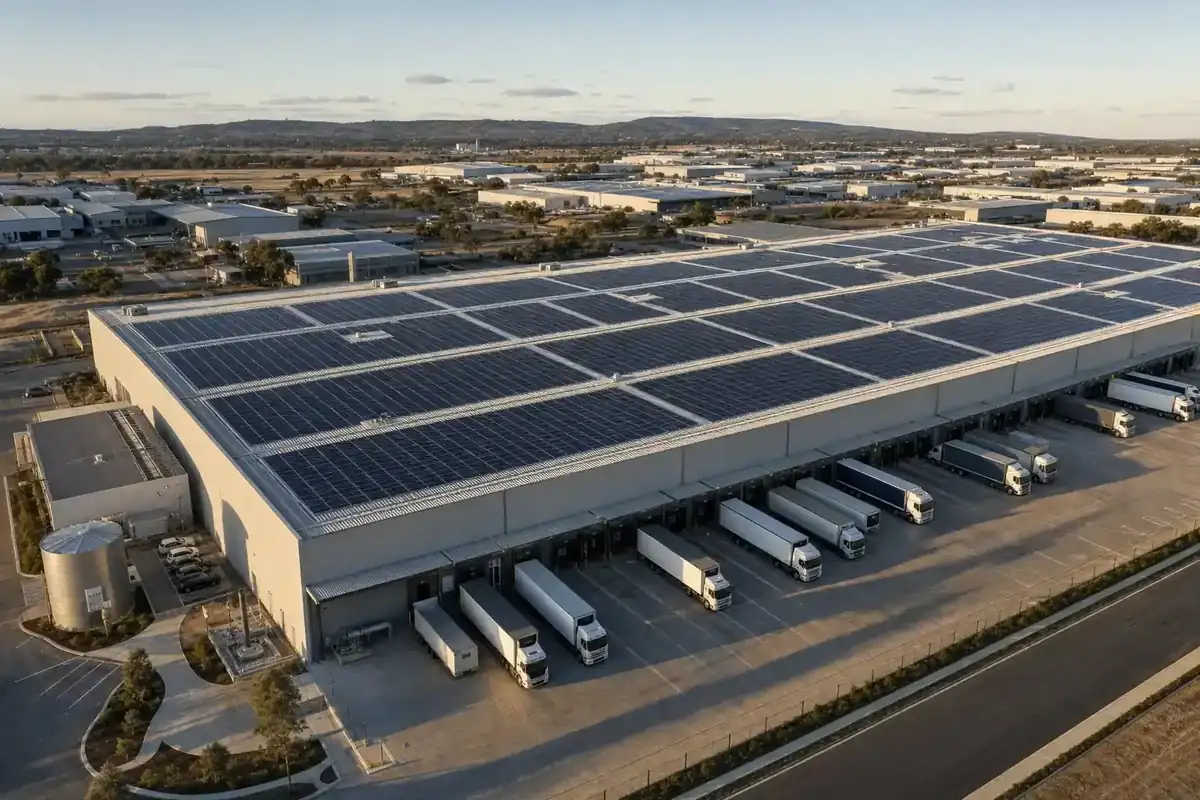
See what this looks like on your roof
Send us your site details and recent power bills. We'll model the system, savings and payback and put real numbers in front of you, at no cost.
- Free feasibility assessment
- Transparent pricing and payback
- No obligation to proceed
Free quote
Want the numbers for your site?
We model system size, savings and payback before you commit to anything.
(08) 7093 6389FAQ
Frequently asked questions
The number of chargers depends on fleet size, daily km range, overnight dwell time and the charger output. For a fleet where all vehicles return to depot overnight with 8+ hours available, one 7kW charger per two vehicles is often sufficient. For shift-based operations or fleets that need a full charge in under 3 hours, one charger per vehicle at 22kW is more appropriate. We calculate the requirement from your fleet utilisation data.
Yes, if the solar system has sufficient capacity and the charging load profile aligns with the generation window. We assess your existing solar system size, generation data and the fleet charging energy requirement. In many cases, adding EV charging is a strong justification for expanding an existing solar system to cover the incremental load.
AC Level 2 chargers require a 3-phase supply in most commercial installations. DC fast chargers require a 3-phase supply with sufficient cable sizing for the peak output. The main switchboard must have capacity to accommodate the charger load, and the network connection capacity must support the additional draw. We assess all of these before specifying charger types.
Federal and state incentive programs change regularly. At the time of writing, there are programs supporting business EV adoption and charging infrastructure through the Australian Renewable Energy Agency (ARENA) and various state initiatives. We recommend checking current SA and federal programs at the time of your project. We are familiar with grant application requirements and can assist with applications.
A simple installation of 2-4 AC chargers on an existing 3-phase supply with sufficient capacity can typically be completed in 1-2 days. Larger installations requiring switchboard upgrades, trenching for underground conduit or network connection upgrades will take longer. Projects requiring SAPN involvement for capacity upgrades follow the same network approval timeline as solar projects.
Yes. Modern smart charging platforms allow access control by RFID card, app-based authentication or simply open access for customer use. You can set different pricing or access rules for staff, fleet vehicles and visitors. Usage data is reported by charger and user, which supports cost allocation and charger utilisation analysis.
Start with the numbers, not a sales pitch.
Book a free feasibility assessment and we will model the system, savings and payback for your site before you commit to anything.