
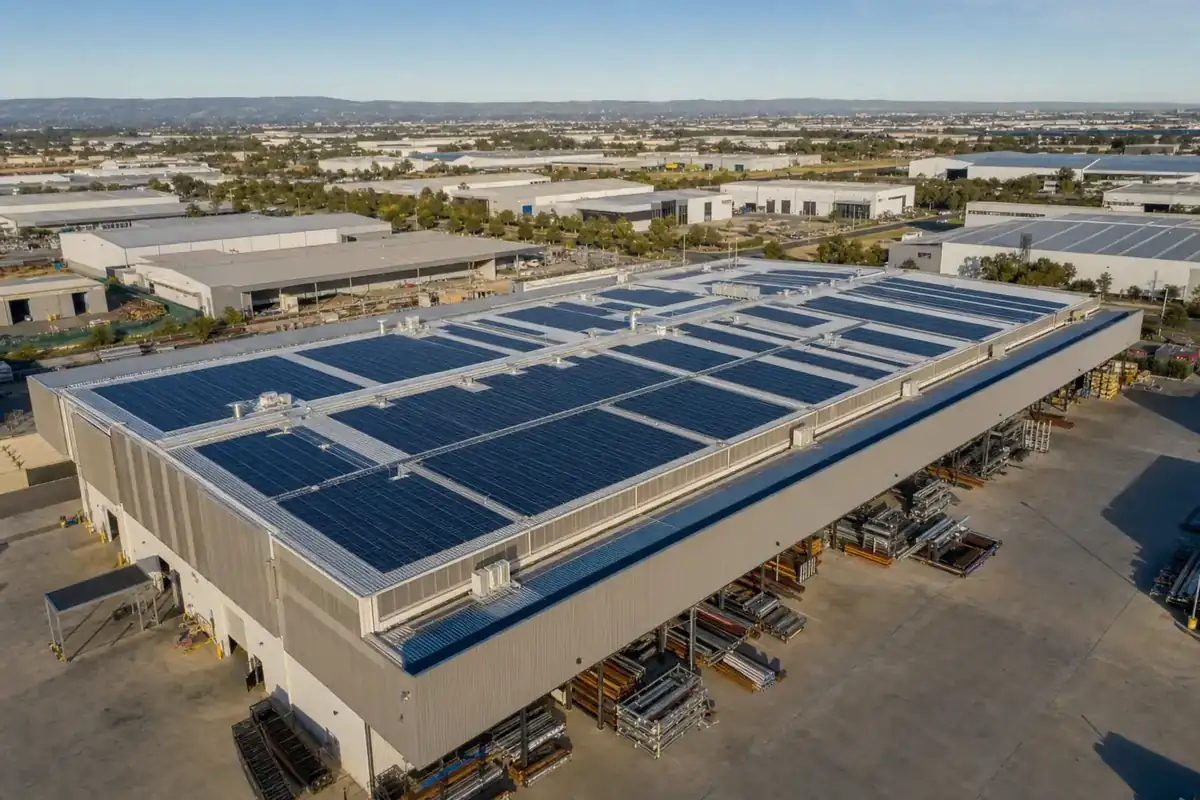
Commercial Solar for Adelaide Manufacturing
SA manufacturing and fabrication plants run the most predictable load profiles in commercial solar. We size every system to your actual plant load, not a sales target.
 4.9Google rating328 reviews
The load profile
Why solar fits manufacturing & fabrication
Manufacturing and fabrication facilities across South Australia operate some of the most energy-intensive load profiles in the commercial sector. CNC machinery, compressors, welding plant, and ventilation systems draw heavily during production shifts - precisely the daylight hours when a rooftop solar system generates at its peak.
SA's commercial electricity tariffs are among the highest in the country. For manufacturers on time-of-use or demand-based tariffs, a correctly sized solar system can offset 40-70% of daytime grid consumption, producing an indicative payback in the 4-6 year range on systems 100kW and above.

Continuous Daytime Production Load
Manufacturing shifts typically run 6am-6pm, which aligns directly with the solar generation window. Machines, compressors, and ventilation draw consistent base load during those hours, maximising on-site solar consumption.

Demand Charge Exposure
SA network tariffs include demand components charged on peak 15 or 30-minute intervals. Battery storage paired with solar can flatten demand spikes and reduce this charge alongside the energy offset.

Large Roof Area Available
Manufacturing facilities typically have flat or low-pitch roof spans of 1,000-10,000 sqm - well suited to high-density panel arrays from 100kW to 1MW+, maximising generation relative to load.
The numbers
Commercial solar economics for manufacturing & fabrication
Indicative sizing only. Figures vary by location, roof pitch, shading, panel efficiency, and actual load profile.
| Facility Type | Typical System Size | Est. Annual Output | Primary Load Offset |
|---|---|---|---|
| Light fabrication workshop (500-1,000 sqm roof) | 30kW - 80kW | 45,000 - 120,000 kWh | Machines, lighting, ventilation |
| Medium manufacturer (1,000-3,000 sqm roof) | 100kW - 300kW | 150,000 - 450,000 kWh | Heavy plant, compressors, HVAC |
| Large multi-bay facility (3,000+ sqm roof) | 300kW - 1MW+ | 450,000 - 1,500,000 kWh | Full site baseload offset |
| Manufacturer with battery storage | 100kW+ solar + 100-500kWh battery | System-dependent | Baseload plus demand charge reduction |
Indicative figures. Your written proposal models your exact site.
Why it matters
A generic install leaves money on the roof
For a manufacturing & fabrication site, the difference between a catalogue system and a load-matched one is years off your payback.
A generic installer
- Sized to your roof area, not your actual load
- Priced per kW off a catalogue
- One-size panel + inverter bundle
- Demand charges ignored
- Handed off the day it's switched on
Our load-matched approach
- Sized to your real interval data
- Costed line by line for your site
- Panels + inverter matched to your load profile
- Battery + design target peak-demand charges
- Monitored and serviced by the same team
Solar built for manufacturing & fabrication?
Get a free quote. We model the system, savings and payback before you commit to anything.
How we'd approach your site
From power bill to payback
 01
01Load analysis
We pull your interval data and map exactly how and when the site draws power.
 02
02System design
Array, inverter and battery sized to that load, modelled for real generation and self-consumption.
 03
03CEC install
Licensed, insured, in-house installation to SA grid rules, planned around your operating hours to keep disruption to a minimum.
04Monitor & service
Live performance monitoring so the return you were quoted is the return you keep.
What we deliver
Services for manufacturing & fabrication

Commercial Solar Panels & Systems
Engineered rooftop PV from 30kW to 1MW+, sized to your load profile.
Learn more
Commercial Battery Storage
Store daytime generation to slash peak-demand charges and add backup.
Learn moreEnergy Audits & Feasibility
Load analysis and ROI modelling before a single panel is ordered.
Learn moreIn detail
Solar for manufacturing & fabrication, in detail
The economics of commercial solar come down to one core question: how closely does your load match solar generation? Manufacturing and fabrication facilities in South Australia score higher on this measure than almost any other sector in the country.
Production lines, compressors, CNC machines, and workshop ventilation draw consistent, predictable load from around 6am through to late afternoon. That profile overlaps almost perfectly with SA's solar generation window, roughly 7am-5pm on a clear day. Unlike retail or hospitality, where load spikes in evenings fall outside the solar window, a manufacturer's peak consumption lands right in the middle of it.
SA Tariff Rates Accelerate the Numbers
South Australian commercial electricity rates are consistently among the highest in Australia. A manufacturing business paying 25-35c/kWh during peak hours earns a higher effective return on every solar kilowatt-hour generated than a comparable plant in a lower-tariff state. That gap is the reason SA manufacturers report some of the strongest commercial solar ROI in the country.
Many manufacturing businesses focus on reducing their energy (kWh) cost. But SA network tariffs also include demand charges based on your highest 15 or 30-minute consumption interval during a billing period. A battery storage system paired with solar can reduce both components. We model demand charge impact as a separate line in every feasibility assessment.
Sizing to Load, Not to Roof
A 200kW plant running a single production shift has a fundamentally different solar requirement from a 200kW plant running two shifts or continuous production. We start every manufacturing engagement with a 12-month interval-data load analysis, not a rule-of-thumb sizing formula.
Single-Roof vs Multi-Building Configurations
Larger manufacturing sites often span multiple buildings with separate switchboard connections. We design single-connection systems and distributed multi-building arrays that feed a common metering point, maximising total solar capture across the site.
Where a roof's structural condition cannot support a full array, we model the optimal split between rooftop and ground-mounted generation so no available generation capacity is left on the table.
Capital expenditure constraints should not prevent a manufacturing business from accessing commercial solar. Four financing structures suit different balance-sheet positions.
Purchased commercial solar systems may be eligible for accelerated depreciation under current ATO provisions. Confirm eligibility with your accountant - we provide the full asset cost breakdown and technical specifications the ATO requires for the depreciation claim.
Adelaide's manufacturing base runs along a north-south industrial corridor from Edinburgh and Salisbury through Wingfield and Regency Park to Lonsdale and Tonsley. We carry out commercial solar projects across this corridor and in regional South Australia.
- Edinburgh and Salisbury - defence, aerospace, and light manufacturing
- Wingfield and Regency Park - freight, steel, and food processing
- Thebarton and Beverley - automotive components, engineering, and fabrication
- Lonsdale industrial area - heavy fabrication, marine, and chemicals
- Tonsley Innovation District - advanced manufacturing and research facilities
- Port Adelaide and Outer Harbor - maritime, bulk handling, and heavy industry
- Regional SA - manufacturers across the Barossa, Riverland, South East, and Yorke Peninsula
Site assessments and engineering are available statewide. Our team carries out structural assessment, load review, and grid connection pre-application work on-site, wherever your facility sits in South Australia.
A Commercial Project, Managed End to End
Commercial manufacturing solar installations are not residential installs scaled up. Roof loading assessments, switchboard capacity reviews, network connection agreement timelines, and structural engineering certifications all require experienced site coordination and careful project management.
We size the system to your load profile, not a sales target. That means the feasibility model and the installed system tell the same story.
Commercial Solar Adelaide
Our process runs from initial load analysis through detailed design, engineering certification, SA Power Networks connection application, installation, and commissioning - with a single point of contact throughout. We do not hand the project off to a subcontractor at the install stage.
After commissioning, every manufacturing system is connected to live monitoring that tracks generation output, consumption offset, and system health. If performance drops below expected levels, our operations team investigates before it affects your return.
Next step
Model the numbers for your manufacturing & fabrication site
Send us your site details and recent power bills. We'll size a system to your load and show the savings and payback, at no cost.
- Free feasibility assessment
- Sized to your load profile
- Transparent payback
Free quote
Want the numbers for your site?
We model system size, savings and payback before you commit to anything.
(08) 7093 6389FAQ
Frequently asked questions
System size depends on your actual load profile, not the size of your roof alone. A load analysis using 12 months of interval data typically identifies the optimal system between 50kW and 500kW for most SA manufacturers. We always size to your consumption, not a maximum roof-fill.
Solar alone may not reduce demand charges, which are triggered by your peak 15 or 30-minute consumption interval. A battery storage system paired with solar can absorb those peak intervals, reducing the demand component alongside the energy component that solar directly displaces.
A 100-300kW rooftop installation typically takes 4-8 weeks from contract to commissioning, including SA Power Networks connection approval. Larger systems or those requiring structural engineering can extend that timeline. We provide a full project programme at the design stage.
All manufacturing installs begin with a structural engineering assessment of the existing roof. We work with roof warranty holders and certifiers to ensure the installation method is documented and does not void any existing coverage. This is standard on all our commercial projects.
The system continues generating during shutdowns and can export surplus electricity to the grid under a feed-in arrangement. We model shutdown periods during feasibility so you receive an accurate annual generation estimate, not one that assumes full production every day.
Start with the numbers, not a sales pitch.
Book a free feasibility assessment and we will model the system, savings and payback for your site before you commit to anything.