

Solar PPA & Financing in Adelaide
Zero-upfront power purchase agreements and commercial finance options that put solar cash-flow positive from the first billing cycle.
 4.9Google rating328 reviews
Why it pays
The case for solar ppa & financing

Zero upfront capital outlay
Under a PPA structure, the finance provider funds the full system cost. You sign an electricity supply agreement and start receiving cheaper energy immediately.

Positive cash flow from month one
In most Adelaide commercial scenarios, the monthly electricity saving exceeds the loan repayment or PPA payment from the first billing cycle. The system pays its own way.

Finance structures to match your balance sheet
We model PPA, chattel mortgage, commercial loan and equipment finance side by side so you can choose the structure that best fits your accounting treatment and cash flow.
The numbers
What to expect
Tax treatment is indicative only. Confirm accounting and tax implications with your qualified adviser before making investment decisions.
| Factor | Solar PPA | Cash Purchase | Equipment Finance / Chattel Mortgage |
|---|---|---|---|
| Upfront cost | Nil | Full system cost | Deposit or nil (lender-dependent) |
| Ownership | Finance partner | Your business | Your business (financed) |
| Maintenance responsibility | Finance partner | Your business (O&M contract) | Your business (O&M contract) |
| Tax treatment | Operating expense (check with accountant) | Depreciation + instant write-off (check eligibility) | Interest deductible + depreciation (check with accountant) |
| End-of-life risk | None (owner manages) | Your responsibility | Your responsibility |
| Long-term return | Lower (PPA payments continue) | Highest after payback | High after loan repayment |
| Balance sheet impact | Minimal (off-balance sheet - confirm with accountant) | Capital asset | Financed liability + asset |
Indicative figures. Your written proposal models your exact site.
Why it matters
Engineered for your site, not off the shelf
The system that pays back fastest is the one built around how you actually use power, not a bundle off a price list.
Off-the-shelf install
- A kW figure straight off a price list
- A standard panel + inverter bundle
- Roof filled regardless of your load
- Export you barely get paid for
- Installed, then forgotten
Our engineered approach
- Sized to your actual power bills
- Panels + inverter matched to your site
- Built to maximise self-consumption
- Battery + design to cut peak-demand charges
- Monitored and serviced by our own team
Thinking about solar ppa & financing?
Get a free quote. We model the system, savings and payback before you commit to anything.
How we work
A clear path from enquiry to switch-on
Feasibility and sizing
We assess your roof, load data and tariff. The system is sized to maximise your self-consumption and minimise the PPA rate relative to your current tariff.
PPA agreement executed
You sign a power purchase agreement with the finance partner, typically for a 10-20 year term. The contracted PPA rate is set below your current grid tariff and may have a fixed escalation clause.
Finance partner owns and installs the system
The finance partner funds installation. All equipment, warranties and insurance sit with the system owner. You have no ownership liability.
You buy electricity from the system at the PPA rate
A generation meter measures the energy your roof produces. You are invoiced at the PPA rate for that energy. Any remaining demand is still purchased from your grid retailer.
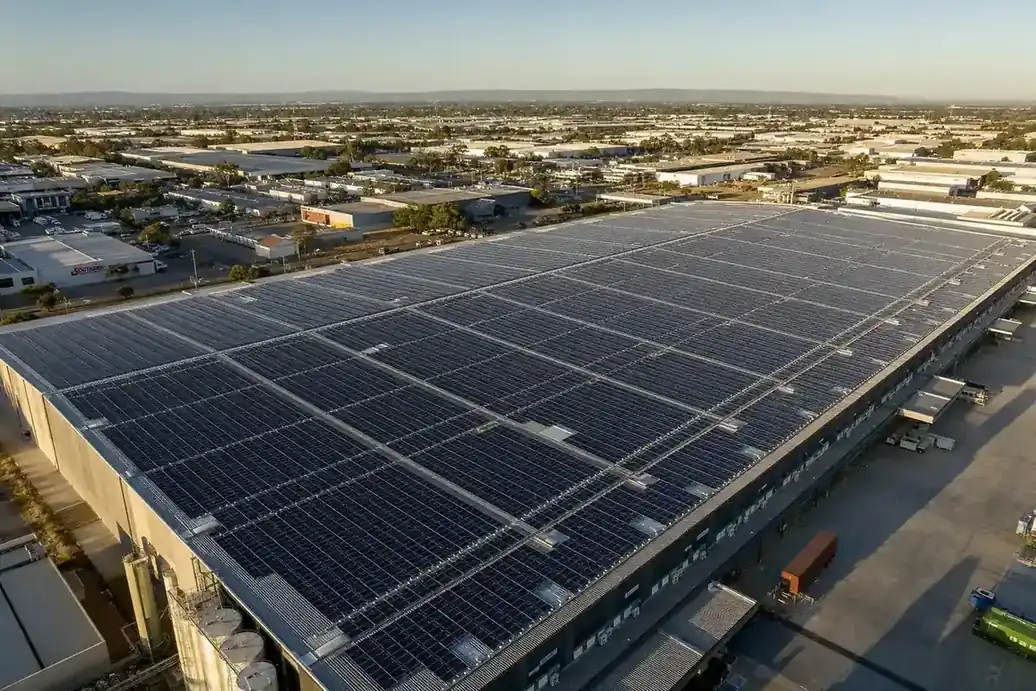
Adelaide & South Australia
A commercial roof is a balance-sheet asset
Put the sun on your roof to work. We design, install and finance systems that pay for themselves and keep saving for decades.
End to end
Everything included, under one roof
In detail
The detail that matters
Design, install and finance under one roof. We structure the numbers so the solar pays for itself before we ask for a signature.
Commercial Solar Adelaide
The choice between a PPA and ownership finance depends on your tax position, balance sheet strategy and appetite for long-term return. The table below summarises the key differences.
Subject to current ATO rules and your accountant confirming eligibility, the full system cost may be immediately deductible in the year of installation, which can make cash purchase the strongest financial option for profitable businesses. Confirm with your accountant before deciding on structure.
Commercial loan and chattel mortgage
A chattel mortgage gives your business ownership of the system from day one. The lender takes a security interest in the asset. Monthly repayments are typically structured so the energy saving exceeds the repayment, delivering positive cash flow from the first statement.
Equipment finance and green finance
Several Australian banks and specialist clean energy lenders offer green finance products with preferential rates for solar and battery assets. We can introduce you to lenders who understand commercial solar as an asset class, which can reduce documentation requirements compared to general commercial lending.
- Chattel mortgage: ownership from day one, interest and depreciation deductible (confirm with accountant)
- Operating lease: off-balance sheet treatment in some structures (confirm with accountant)
- Clean energy loan: specific products from banks supporting the energy transition with competitive rates
- Solar PPA: no ownership, no balance sheet liability, guaranteed below-tariff energy rate
- Commercial line of credit: flexibility for businesses with existing lending relationships
A realistic Adelaide finance scenario
A 100kW system on an Adelaide warehouse with a daytime load of 120kW generates approximately 140,000-160,000 kWh per year. If the business self-consumes 75% of that generation, the annual energy saving at a tariff of $0.28-$0.35 per kWh is roughly $29,000-$42,000 (indicative, depends on actual tariff and generation). Finance repayments on $90,000 over 5 years at a commercial rate are typically $18,000-$22,000 per year. That leaves a net cash flow positive position in year one.
Every figure in a commercial solar financial model depends on your actual tariff, your actual interval data load profile and the actual irradiance at your roof orientation. We do not use generic assumptions. We pull your data and build a model specific to your site before presenting a finance recommendation.
A solar PPA is a long-term electricity supply agreement. The contract term, rate escalation clause, performance guarantee and end-of-term options all have a material impact on the total value of the arrangement. These are the terms Adelaide businesses should review carefully before executing.
| Contract Term | What to Check | Why It Matters |
|---|---|---|
| PPA rate and annual escalation | The starting rate relative to your current tariff and whether escalation is fixed, CPI-linked or subject to a cap | A low starting rate with high uncapped escalation can erode savings in later years. Model the rate trajectory to year 10 before signing. |
| Minimum generation guarantee | Whether the PPA includes a minimum generation commitment from the system owner | Without a guarantee, you have no contractual remedy if the system underperforms due to poor maintenance by the owner. |
| Maintenance and performance obligation | Who is responsible for monitoring, panel cleaning, fault repair and inverter replacement over the term | System owners have a financial incentive to maintain performance, but the maintenance obligation should be confirmed in the contract. |
| End-of-term options | Whether you have the right to purchase at fair market value, renew at a renegotiated rate or require removal at no cost | A purchase option preserves flexibility at end of term. A removal obligation on the system owner protects you from a decommissioning cost. |
| Site access and building transaction clauses | Whether the PPA restricts your ability to sell, lease or structurally modify the building during the contract term | A building sale or major roof refurbishment can trigger a PPA assignment or early termination clause with associated costs. |
The core test of a PPA is whether the contracted rate - accounting for escalation over the term - remains below your projected grid tariff across the full contract life. We model both the PPA rate trajectory and a projected tariff escalation scenario so you can see the economic crossover point before committing.
- 01Obtain your current full tariff schedule
Request the full tariff schedule from your retailer, including network charges. This is the baseline the PPA rate needs to beat across the contract term.
- 02Model the PPA rate trajectory across the contract term
Apply the escalation clause to the starting PPA rate for each year of the contract. Compare against a projected grid tariff escalation of 3-5% per year to identify the value crossover point.
- 03Confirm maintenance obligations in writing
Ask the PPA provider to confirm in writing their monitoring, maintenance and fault-response obligations. These should be equivalent to what you would receive under a paid O&M contract.
- 04Review with your solicitor and accountant
A PPA is both a legal and financial instrument. Have your solicitor review the full agreement and your accountant confirm the accounting treatment before executing.




Next step
See what this looks like on your roof
Send us your site details and recent power bills. We'll model the system, savings and payback and put real numbers in front of you, at no cost.
- Free feasibility assessment
- Transparent pricing and payback
- No obligation to proceed
Free quote
Want the numbers for your site?
We model system size, savings and payback before you commit to anything.
(08) 7093 6389FAQ
Frequently asked questions
A solar PPA is an electricity supply agreement. A third-party company installs and owns the solar system on your roof and sells you the electricity it generates at a contracted rate below your current grid tariff. You receive cheaper power immediately with no upfront cost. When you buy a system, you own the asset, take the STC incentive, depreciate it and keep all future savings after the loan is repaid.
In many Adelaide commercial scenarios, yes. If the monthly energy saving exceeds the loan repayment or PPA payment, the system cash flows positively from the first billing cycle. This depends on your current tariff, the system size, your self-consumption rate and the finance terms. We model this specifically for your site before recommending a structure.
Most PPA contracts offer three options at the end of the term: purchase the system at fair market value, extend the agreement at a renegotiated rate or have the system removed at no cost to you. The buyout option is typically the most common choice because the system still has 5-15 years of economic life after a 10-year PPA term.
A true operating PPA is typically treated as an operating expense and may not appear as a liability on the balance sheet, though accounting treatment depends on the specific contract structure and your accountant interpretation of relevant accounting standards. Confirm the balance sheet impact with your accountant and lender before signing.
Commercial solar finance is typically available over 3-7 years for systems under $500,000 and up to 10 years for larger projects. Green finance products from specialist lenders can offer competitive rates and may have longer terms. PPA agreements typically run 10-20 years. We present the full range of options so you can select the term that suits your planning horizon.
Yes. Small-scale Technology Certificates (STCs) reduce the upfront cost of any system under 100kW and are applied as a point-of-sale discount before finance is arranged. Large-scale systems above 100kW may be eligible for Large-scale Generation Certificates (LGCs) over the system life rather than a lump-sum STC discount. We explain the applicable incentive for your system size during the feasibility stage.
Start with the numbers, not a sales pitch.
Book a free feasibility assessment and we will model the system, savings and payback for your site before you commit to anything.