
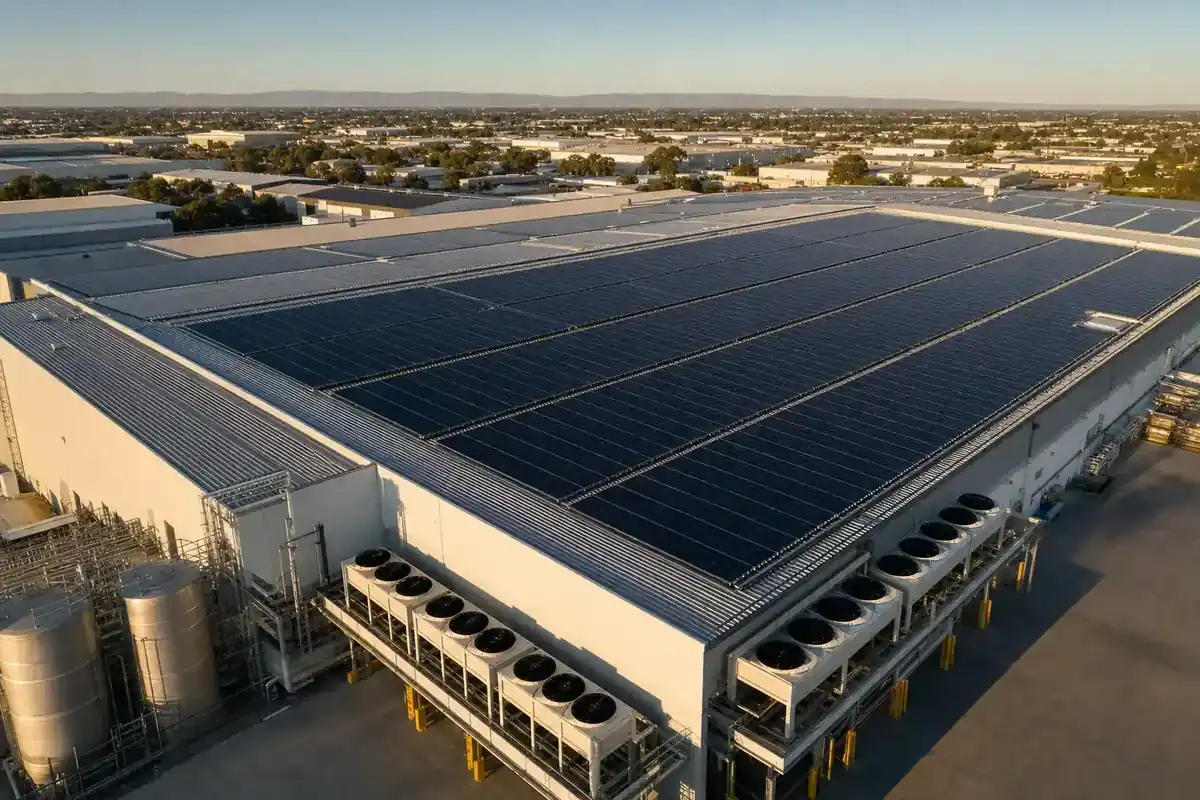
Commercial Solar for Adelaide Cold Storage
High-load refrigeration facilities carry one of the heaviest energy bills in the SA commercial sector. We engineer solar and battery systems around your 24/7 load, not a standard commercial template.
 4.9Google rating328 reviews
The load profile
Why solar fits cold storage & refrigeration
Cold storage and refrigeration facilities carry a unique energy challenge: the load never stops. Chillers, blast freezers, and refrigerated dock doors draw power 24 hours a day, 7 days a week - creating one of the highest electricity bills per square metre of any commercial building type in South Australia.
The good news is that the daytime portion of that load - typically 50-65% of total consumption for facilities operating day-shift coolroom access and defrost cycles - aligns well with solar generation. Combined with battery storage to handle peak demand intervals, a correctly engineered system can produce a substantial reduction in both energy spend and network charges.

24/7 Baseline Refrigeration Draw
Compressors and refrigeration plant never switch off. This creates a high, constant baseline load. Solar offsets the daytime portion; battery storage extends that offset into evening peak intervals.

SA Summer Heat Amplifies Both Load and Solar Output
Adelaide's summer heat forces refrigeration compressors harder precisely when solar output is at its seasonal peak. The two curves work in favour of solar economics for cold storage operators.

Daytime Defrost and Access Cycles
Defrost cycles, coolroom door openings, and staff activity concentrate additional load during daylight hours. Solar captures this load directly, reducing the proportion that must be drawn from the grid.
The numbers
Commercial solar economics for cold storage & refrigeration
Indicative ranges only. All system sizes are determined by interval-data load analysis and site-specific factors.
| Facility Type | Typical Solar System | Battery Storage Add-On | Primary Benefit |
|---|---|---|---|
| Small cool room complex (under 2,000 sqm) | 30kW - 80kW | 50-100kWh optional | Daytime compressor offset |
| Medium cold store (2,000-6,000 sqm) | 100kW - 300kW | 200-500kWh recommended | Daytime offset plus peak demand reduction |
| Large distribution cold store (6,000+ sqm) | 300kW - 800kW | 500kWh - 2MWh | Baseload offset plus evening peak coverage |
| Blast freeze or hardening facility | 200kW - 500kW | 500kWh - 1MWh (demand spike suppression) | Demand charge reduction is the primary driver |
Indicative figures. Your written proposal models your exact site.
Why it matters
A generic install leaves money on the roof
For a cold storage & refrigeration site, the difference between a catalogue system and a load-matched one is years off your payback.
A generic installer
- Sized to your roof area, not your actual load
- Priced per kW off a catalogue
- One-size panel + inverter bundle
- Demand charges ignored
- Handed off the day it's switched on
Our load-matched approach
- Sized to your real interval data
- Costed line by line for your site
- Panels + inverter matched to your load profile
- Battery + design target peak-demand charges
- Monitored and serviced by the same team
Solar built for cold storage & refrigeration?
Get a free quote. We model the system, savings and payback before you commit to anything.
How we'd approach your site
From power bill to payback
 01
01Load analysis
We pull your interval data and map exactly how and when the site draws power.
 02
02System design
Array, inverter and battery sized to that load, modelled for real generation and self-consumption.
 03
03CEC install
Licensed, insured, in-house installation to SA grid rules, planned around your operating hours to keep disruption to a minimum.
04Monitor & service
Live performance monitoring so the return you were quoted is the return you keep.
What we deliver
Services for cold storage & refrigeration

Commercial Solar Panels & Systems
Engineered rooftop PV from 30kW to 1MW+, sized to your load profile.
Learn more
Commercial Battery Storage
Store daytime generation to slash peak-demand charges and add backup.
Learn moreSolar Monitoring & Maintenance
Live performance monitoring and servicing to protect your return.
Learn moreIn detail
Solar for cold storage & refrigeration, in detail
Cold storage and refrigeration facilities pay some of the highest electricity bills in the SA commercial sector. A large cool store or blast-freeze facility can spend $200,000-$600,000 per year on electricity at current SA C&I tariff rates. Even a 30-40% reduction in daytime grid consumption represents a material saving that flows directly to operating margin.
The case for solar strengthens further when SA's summer climate is considered. Adelaide is the hottest mainland capital in Australia. Peak summer temperatures force refrigeration plant to work hardest in December and January - the same months when SA rooftop solar produces its highest daily output. The load and the generation peak together, which is the ideal solar scenario.
Why Storage Matters More for Cold Storage Than Other Sectors
In most commercial solar applications, the goal is to maximise daytime self-consumption. For cold storage facilities, that goal extends into the evening peak window (4pm-9pm on most SA C&I tariffs) when grid tariff rates are highest and the refrigeration load remains constant. A battery storage system charged by excess solar during the day can discharge across that peak window, reducing grid spend at the highest-rate part of the day.
A blast-freeze facility pulling high amperage on compressor start-up has a very different demand profile from a steady-state cool room running at constant temperature. We model both cases separately in our load analysis because they require different battery sizing and control strategies to achieve the demand charge reduction you are targeting.
Solar Sizing Driven by Refrigeration Circuit Data
We request interval data for each major refrigeration circuit, not just the whole-site meter. That granularity lets us identify which circuits run during solar hours, which trigger demand peaks, and where battery charge-discharge cycles deliver the highest bill reduction.
Roof Considerations for Cold Storage Buildings
Cold storage buildings often have insulated panel roofs with specific structural load limits and penetration constraints. We conduct roof structural assessments before any design is finalised and use mounting systems compatible with insulated panel construction. Roof warranty requirements are reviewed and documented as part of the engineering package.
Battery storage plays a more important role in cold storage solar projects than in most other commercial applications. The reasons come down to the specific structure of cold storage energy bills.
- Evening peak tariff rates (4pm-9pm) are when refrigeration load is high but solar generation has ceased
- Demand charges are triggered by compressor start-up spikes that battery systems can suppress
- Feed-in tariff rates in SA are low - surplus solar is worth more consumed on-site via battery than exported to the grid
- Battery provides backup capacity during grid outages, protecting refrigerated stock from temperature excursion
- LG, BYD, and Tesla Megapack commercial battery systems are available in configurations from 50kWh to multi-MWh for large facilities
A battery storage system with appropriate inverter capacity can maintain critical refrigeration circuits during a grid outage for several hours. For cold storage operations holding high-value perishable stock, this backup capability has real commercial value beyond the energy cost reduction.
We size battery storage to the demand and peak-shifting opportunity identified in the load analysis, not to a round-number capacity. A 200kWh battery correctly sized and configured will outperform a 500kWh battery installed without proper load modelling.
Adelaide's cold storage and refrigeration sector is concentrated in the northern and western industrial precincts, with significant regional facilities in the Riverland, Barossa, and Fleurieu food production zones.
- Wingfield and Gepps Cross - large-scale distribution cold stores and frozen goods facilities
- Edinburgh North and Direk - food manufacturing and cold distribution
- Regency Park and Ottoway - wholesale produce and refrigerated transport hubs
- Riverland (Renmark, Berri, Loxton) - stone fruit, citrus, and table grape cold storage
- Barossa Valley and Eden Valley - winery barrel halls and bottled wine cold storage
- McLaren Vale and Fleurieu Peninsula - boutique winery cold stores and olive oil storage
Regional facilities often have better roof access, simpler network connection processes, and in some cases access to agricultural power tariffs that change the feasibility calculation. We model all of these factors in the site-specific assessment.
What a Cold Storage Feasibility Assessment Covers
Cold storage solar feasibility requires more detailed analysis than a standard commercial site. The assessment we deliver covers interval load data by circuit, solar generation modelling calibrated to SA irradiance data, battery charge-discharge modelling against real tariff structures, demand charge reduction modelling, and a 25-year discounted cash flow with sensitivity analysis.
A commercial roof is a balance sheet asset. For cold storage operators, that is especially true - the energy savings from a correctly engineered system can materially improve operating margin.
Commercial Solar Adelaide
We present the feasibility before we ask you to commit to a system. That means the numbers you see in the proposal match the numbers the installed system will produce - not a best-case marketing estimate.
Next step
Model the numbers for your cold storage & refrigeration site
Send us your site details and recent power bills. We'll size a system to your load and show the savings and payback, at no cost.
- Free feasibility assessment
- Sized to your load profile
- Transparent payback
Free quote
Want the numbers for your site?
We model system size, savings and payback before you commit to anything.
(08) 7093 6389FAQ
Frequently asked questions
Yes. Even though refrigeration runs 24/7, the daytime portion of that load - typically 50-65% of total consumption - aligns directly with solar generation. Battery storage then extends that offset into the evening peak tariff window. The combination can produce a 30-50% reduction in grid electricity purchases on most cold storage sites.
Battery sizing depends on the size of your evening peak load and your demand charge exposure. We model your interval data before recommending a size. For a medium cold store, 200-500kWh of battery capacity is a common starting point, but we size to your specific demand spike profile, not a standard package.
Battery storage with appropriate inverter configuration can maintain critical refrigeration circuits during a grid outage for a limited period. The duration depends on battery capacity and the load of the circuits you prioritise. We can design backup capability into the system if protecting stock from temperature excursion is a priority.
Yes. Insulated panel roofs have specific structural load limits and penetration requirements. We conduct a structural assessment before design and use mounting systems that are compatible with insulated panel construction and do not compromise the building envelope or your roof warranty.
Summer is your best solar scenario. Adelaide summer heat forces refrigeration compressors harder - increasing your load - at precisely the time SA solar output is at its seasonal peak. The two curves reinforce each other, producing the strongest solar offset during the months when your energy bill is highest.
Start with the numbers, not a sales pitch.
Book a free feasibility assessment and we will model the system, savings and payback for your site before you commit to anything.