
Commercial Solar Adelaide CBD
Rooftop solar and battery systems for CBD offices, hotels, retail centres and mixed-use buildings, engineered to your load, connected to the SA Power Networks grid.
 4.9Google rating328 reviews
Local coverage
Commercial solar across Adelaide CBD
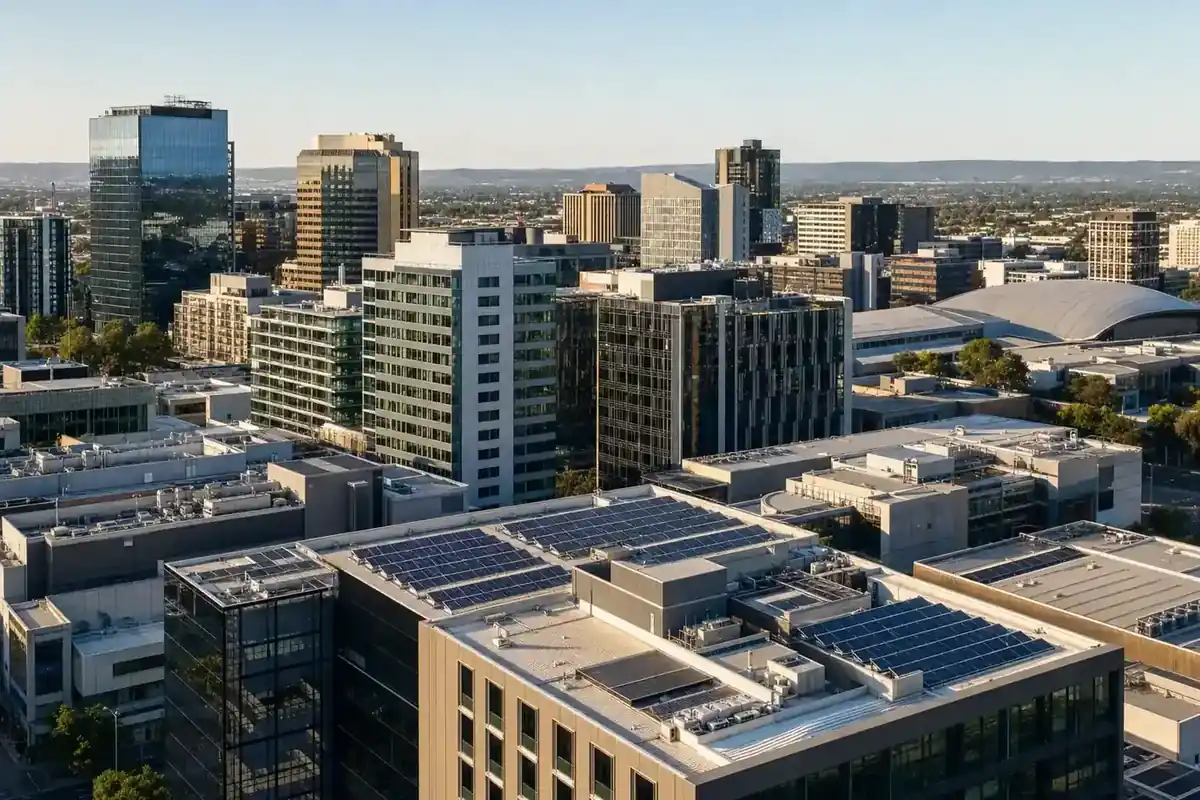
The Adelaide CBD carries some of the highest commercial electricity tariffs in South Australia, with multi-storey offices, hotels and retail tenancies routinely paying network demand charges on top of flat consumption rates. A well-sized rooftop system targets those peak demand windows and cuts the line items that hurt most.
CBD buildings present specific engineering constraints: shared rooftop plant, heritage overlays in parts of the precinct, limited roof area relative to floor area, and body corporate sign-off requirements. Our team has navigated each of these across Adelaide's inner-city commercial stock.
SA Power Networks embedded network rules for CBD substations differ from suburban feeders. We handle the connection application, protection relay settings and metering configuration so your project stays on programme.
Suburbs and precincts we cover
Local, not a call centre
A local team for Adelaide CBD, not a national hotline
When your system needs attention, it matters who actually picks up, and who turns up.
A national installer
- A 1800 number in another state
- Local installers subcontracted out
- A satellite 'design', no site visit
- Slow to respond when something's off
- Sized off a template
Us, on the ground in SA
- A South Australian team you can call
- We install and service it ourselves
- A real on-site inspection first
- Local, fast response
- Sized to your actual load
Get solar on your Adelaide CBD site
Get a free quote. We model the system, savings and payback before you commit to anything.
How it works locally
Getting solar on your Adelaide CBD site
Book a site visit
Tell us about your premises and send a recent power bill. We book a time that suits your operation.
On-site assessment
We inspect the roof, switchboard and metering on the ground, not from satellite imagery.
Costed proposal
You get a system sized to your load with transparent pricing, savings and payback for your site.
Local install & support
Our accredited team installs, commissions monitoring and services the system locally.
The numbers
What to expect locally
Indicative ranges based on Adelaide CBD load profiles. Your feasibility report provides project-specific modelling.
| Building Type | Typical Array Size | Est. Annual Generation | Self-Consumption Rate | Indicative Payback |
|---|---|---|---|---|
| Office tower (NLA 3,000-8,000m2) | 100-200kW | 140,000-280,000 kWh | 70-85% | 4-6 years |
| Boutique hotel (80-150 rooms) | 80-150kW | 110,000-210,000 kWh | 75-90% | 3-5 years |
| Retail tenancy strip | 30-60kW | 42,000-84,000 kWh | 60-75% | 4-7 years |
| Mixed-use (residential above commercial) | 50-100kW | 70,000-140,000 kWh | 65-80% | 5-7 years |
Payback is indicative and subject to tariff, shading analysis and finance structure. Confirm with your accountant for tax treatment.
Why local business chooses us
Engineered commercial solar across metro Adelaide
Local knowledge, accredited installs and systems sized to how your business actually uses power.
On-site in Adelaide CBD
We come to your site
Every proposal starts with a real inspection across Adelaide CBD. We assess the roof, switchboard and load before designing anything.
(08) 7093 6389What we do here
Popular services in Adelaide CBD

Commercial Solar Panels & Systems
Engineered rooftop PV from 30kW to 1MW+, sized to your load profile.
Learn more
Commercial Battery Storage
Store daytime generation to slash peak-demand charges and add backup.
Learn more
Solar PPA & Financing
Zero-upfront power purchase agreements and finance that cash-flows from day one.
Learn moreLocal detail
Commercial solar in Adelaide CBD, in detail
Adelaide CBD electricity costs have tracked well above the national average on a per-kWh basis for several years. Demand tariffs, which charge for your peak 30-minute consumption window each month, can account for 30-40% of a hotel or office building's total energy bill. Solar directly offsets the midday consumption peak that drives those demand charges.
Buildings with flat concrete or membrane roofs in the CBD generally suit ballasted mounting systems that require no penetrations, keeping body corporate and building owner approval simpler. We provide structural load calculations for every project as part of the feasibility report.
Several CBD and North Adelaide properties sit within heritage overlay zones. In many cases solar can still proceed on non-visible roof planes or behind parapet screens. We assess heritage constraints at feasibility stage, not after equipment is ordered.
The Adelaide CBD is supplied through high-voltage substations with different protection requirements from residential feeders. Embedded generation applications for commercial systems above 30kW require a technical study, relay coordination report and, in some cases, an augmentation contribution to the substation.
CBD projects typically run on an 8-14 week timeline from feasibility approval to energisation, depending on SAPN queue times for technical studies. We flag the current queue at your first briefing so you can plan accordingly.
The financial case for CBD solar turns on three variables: your tariff structure, the building's self-consumption rate, and whether you can pair the array with battery storage to shift afternoon generation into the evening peak. We model all three at feasibility stage.
A commercial roof is a balance sheet asset. The panel array generates energy at a cost that locks in on day one, while grid tariffs keep rising.
Commercial Solar Adelaide engineering team
Time-of-Use Shifting in Adelaide's Market
Adelaide's wholesale electricity spot prices are volatile, particularly during summer afternoon peaks when air conditioning load is high across the CBD. A commercial battery system sized against your building's afternoon ramp can shift solar generation into the 4pm-8pm window when grid tariffs are highest.
Demand Charge Reduction
For buildings on maximum demand tariffs, a battery operating in peak-shaving mode targets the monthly peak window. Even a 30-minute discharge at the right moment can reduce the demand charge component for the entire month. This is often the fastest financial payback pathway in CBD commercial buildings.
- LFP (lithium iron phosphate) battery chemistry for commercial applications - safer thermal profile in occupied buildings
- BMS integration with building management systems (BMS) for coordinated dispatch
- Backup power capability for critical loads such as server rooms and emergency lighting
- VPP (virtual power plant) enrolment available through select retail partners for additional revenue
- Real-time monitoring and remote dispatch adjustment via cloud platform
South Australian businesses may be eligible for incentive support under state government battery programs. Scheme rules and eligibility change regularly - we confirm current availability at your feasibility briefing. Never rely on a sales quote for scheme figures; your written proposal shows the current applicable amounts.
Office Buildings and Commercial Towers
Multi-storey offices benefit most from solar when HVAC and elevator loads run from 8am to 6pm, aligning well with peak solar generation hours. Shared services metering and split between tenants and building owners is something we structure at design stage.
Hotels and Hospitality
Hotels carry high hot water, HVAC and kitchen loads around the clock. Solar sized against laundry, kitchen and common-area consumption in the midday window consistently delivers self-consumption rates above 80% for properties in Adelaide's CBD and North Adelaide precinct.
Retail and Food Premises
Supermarkets, large-format retail and food courts run continuous refrigeration and lighting loads that match well with solar generation profiles. These are among the strongest financial cases for rooftop solar in the Adelaide CBD strip along Rundle Mall and its surrounds.
- Strata and body corporate project management and owner approval facilitation
- Embedded network design for multi-tenancy buildings
- Metering and sub-metering configuration for cost allocation
- EV charging infrastructure integration with solar and battery
- Green building rating contributions for NABERS and Green Star
Next step
Book your Adelaide CBD assessment
Tell us about your site and we'll model the system, savings and payback before you commit to anything.
- Free on-site assessment
- Transparent pricing and payback
- Local install team
Other areas we serve
Free quote
Want the numbers for your site?
We model system size, savings and payback before you commit to anything.
(08) 7093 6389FAQ
Frequently asked questions
Often yes. Heritage overlay assessment is site-specific and depends on visibility from the street and the consent of the State Heritage Council where applicable. In many CBD and North Adelaide cases, panels installed on non-visible roof planes or behind existing parapets are approved without issue. We assess heritage constraints at feasibility stage before any cost is committed.
CBD substations operate at higher fault levels than suburban networks. Systems above 30kW typically require a technical study from SAPN before a connection agreement is issued. We prepare and submit the embedded generation application, coordinate the technical study, and manage the connection agreement through to metering and energisation.
A 3,000-8,000m2 NLA office typically suits a 100-200kW array, depending on available roof area, shading from adjacent buildings, and the building's load profile. We pull 12 months of NMI interval data at feasibility stage to size the system to your actual consumption pattern rather than a rule-of-thumb.
Yes, and this is often the most financially significant benefit for CBD buildings. Demand tariffs charge based on your highest 30-minute consumption window each month. Solar generation during peak business hours directly reduces that peak. Adding battery storage and a peak-shaving controller takes this further, clipping demand spikes even when cloud cover reduces solar output.
Most CBD projects run 8-14 weeks from signed feasibility approval to energisation. The variable is SAPN's technical study queue, which we flag upfront. Design, equipment procurement and installation typically take 4-6 weeks once the connection agreement is received.
Start with the numbers, not a sales pitch.
Book a free feasibility assessment and we will model the system, savings and payback for your site before you commit to anything.