
Commercial Solar Barossa Valley
Engineered rooftop solar for Barossa Valley wineries, cellar doors, food producers and agribusiness - sized to your load, installed by a local SA team.
 4.9Google rating328 reviews
Local coverage
Commercial solar across Barossa Valley
The Barossa Valley is South Australia's premier wine region and one of the country's most recognisable agricultural export zones. Wineries at Nuriootpa and Tanunda run energy-intensive processing, refrigeration and climate-control systems year-round. Cellar doors at Angaston and across the valley floor serve a growing tourism trade with its own electricity demands.
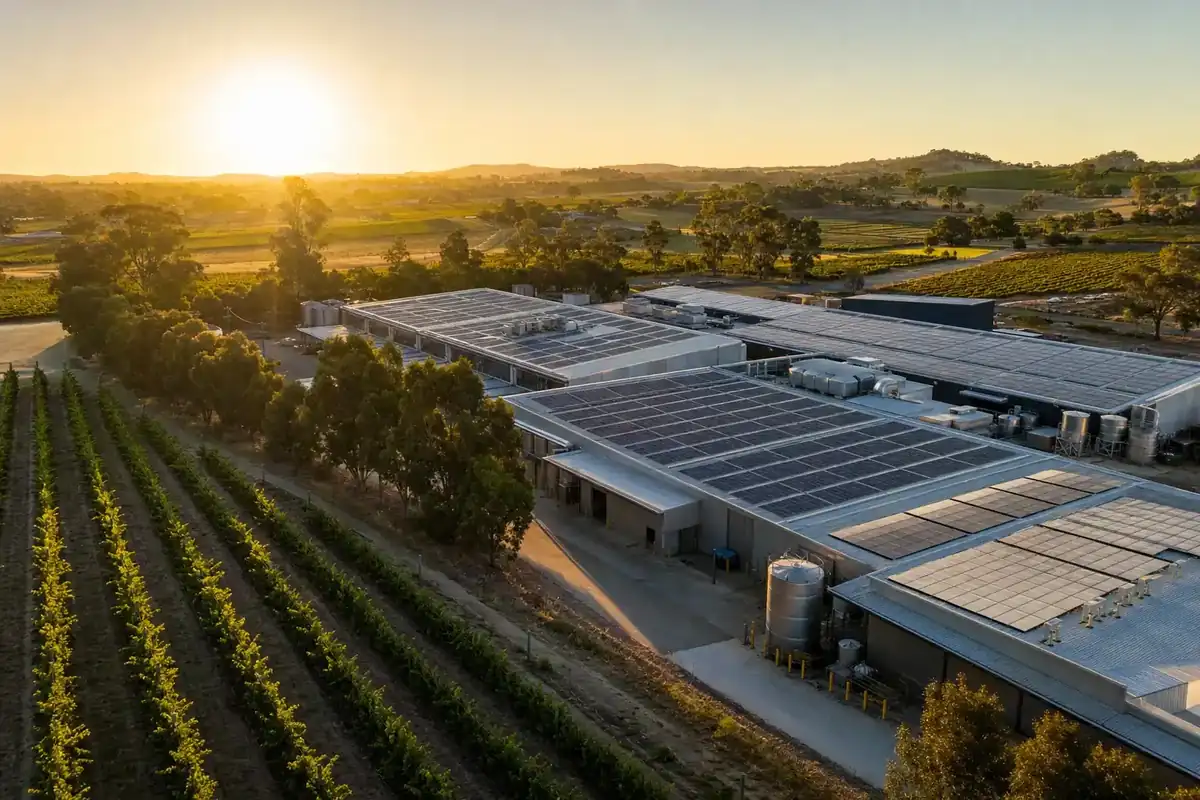
Solar is particularly well-suited to Barossa winery operations. Barrel room refrigeration, tank temperature management and bottling line power run through the day, aligning naturally with solar generation hours. Large shed roofs on production facilities offer ample panel area, and the Barossa's clear SA skies deliver strong annual irradiance.
We design and install commercial solar across the Barossa Valley, from 30kW cellar door systems to 300kW-plus production-facility arrays. Every project starts with your interval meter data and ends with a commissioned system backed by monitoring and ongoing support.
Suburbs and precincts we cover
Local, not a call centre
A local team for Barossa Valley, not a national hotline
When your system needs attention, it matters who actually picks up, and who turns up.
A national installer
- A 1800 number in another state
- Local installers subcontracted out
- A satellite 'design', no site visit
- Slow to respond when something's off
- Sized off a template
Us, on the ground in SA
- A South Australian team you can call
- We install and service it ourselves
- A real on-site inspection first
- Local, fast response
- Sized to your actual load
Get solar on your Barossa Valley site
Get a free quote. We model the system, savings and payback before you commit to anything.
How it works locally
Getting solar on your Barossa Valley site
Book a site visit
Tell us about your premises and send a recent power bill. We book a time that suits your operation.
On-site assessment
We inspect the roof, switchboard and metering on the ground, not from satellite imagery.
Costed proposal
You get a system sized to your load with transparent pricing, savings and payback for your site.
Local install & support
Our accredited team installs, commissions monitoring and services the system locally.
The numbers
What to expect locally
Indicative system sizes for common Barossa Valley operation types
| Operation type | Peak load window | Indicative system size | Primary solar benefit |
|---|---|---|---|
| Large production winery | Continuous refrigeration and processing | 100-300kW+ | Barrel room cooling and demand charge offset |
| Boutique winery and cellar door | Weekend visitor peak and refrigeration | 30-100kW | HVAC, kitchen and refrigeration offset |
| Cellar door - no production | Weekend and holiday visitor periods | 15-50kW | HVAC and lighting during visitor hours |
| Barossa hospitality and accommodation | Weekday and weekend mixed load | 20-60kW | Hot water, HVAC and kitchen offset |
| Barossa food producer | Continuous processing and refrigeration | 50-200kW | Demand charge suppression and energy offset |
System size is determined by interval meter data and roof assessment. These ranges are illustrative only.
Why local business chooses us
Engineered commercial solar across regional SA
Local knowledge, accredited installs and systems sized to how your business actually uses power.
On-site in Barossa Valley
We come to your site
Every proposal starts with a real inspection across Barossa Valley. We assess the roof, switchboard and load before designing anything.
(08) 7093 6389What we do here
Popular services in Barossa Valley

Commercial Solar Panels & Systems
Engineered rooftop PV from 30kW to 1MW+, sized to your load profile.
Learn more
Commercial Battery Storage
Store daytime generation to slash peak-demand charges and add backup.
Learn more
Solar PPA & Financing
Zero-upfront power purchase agreements and finance that cash-flows from day one.
Learn moreLocal detail
Commercial solar in Barossa Valley, in detail
South Australian business electricity is among the most expensive in the country. For Barossa Valley producers, winery operators and hospitality businesses, this cost pressure is a direct margin issue. A rooftop solar system does not change the price your retailer charges for grid electricity - it reduces the amount you need to buy.
The Barossa's energy cost profile is well-suited to commercial solar. High daytime loads from refrigeration and processing, large flat or low-pitch shed roofs, strong annual solar irradiance and SA's high grid tariffs combine to produce payback periods and returns that are among the better available for capital investment in agribusiness infrastructure.
We build a detailed financial model for every Barossa project before you make a decision. This includes energy unit savings, demand-charge impact, STC or LGC incentive value, indicative finance options and a 25-year savings projection. You are buying a modelled return, not solar on faith.
Matching system size to winery load profile
A large-format Barossa winery with continuous barrel room refrigeration, tank temperature management and a working bottling line will have a very different load profile to a boutique cellar door open on weekends. We pull 12 months of NMI interval data before specifying any system. For production wineries, the midday solar generation window typically aligns well with processing and refrigeration loads, producing high self-consumption rates and strong financial returns.
Cold storage and temperature-controlled facilities
Cold-storage facilities attached to Barossa wineries or operating independently in Nuriootpa and Tanunda have continuous electricity loads that make particularly strong solar candidates. Refrigeration compressors cycle throughout the day and respond to ambient temperature, meaning summer electricity costs - when solar generation is highest - are also the most expensive months. A well-sized solar system targets this seasonal alignment directly.
Barossa Valley cellar doors and hospitality operations have a different load profile to production wineries. Visitor peak periods, kitchen and HVAC loads, and event lighting combine around the middle of the day on weekends and during the peak tourism season. For cellar doors with consistent visitor numbers, a 30 to 80kW system typically delivers a solid financial return.
Payback in years, savings for decades. A well-sized system on a Barossa winery or food production shed is one of the few capital investments that pays for itself and continues generating financial return for 25 years.
Commercial Solar Adelaide
Nuriootpa: the Barossa's production hub
Nuriootpa is the commercial and industrial centre of the Barossa Valley, with large winery production facilities, food manufacturing operations and the main commercial strip. Production-scale facilities here typically have large, flat-top sheds with excellent roof area for 100kW to 300kW-plus systems. We are familiar with the SAPN feeder configuration across the Nuriootpa area and factor in any export constraints at the feasibility stage.
Tanunda: heritage precinct and cellar doors
Tanunda's main street and surrounding wine estates include a mix of cellar door operations, hospitality businesses and smaller winery production facilities. Roof profiles vary from older stone and heritage buildings to purpose-built visitor centres and barrel halls. We assess each Tanunda site individually, with particular attention to heritage overlay requirements that may affect installation method and panel visibility from the street.
Angaston: eastern valley wine estates
Angaston's commercial area and surrounding wine estates serve the eastern Barossa. Many Angaston properties feature large, low-pitch roofs on production sheds and barrel stores. The broader Angaston corridor includes several significant wine producers with substantial production footprints and commensurately high electricity loads, making them well-suited to large-format commercial solar installations.
- Nuriootpa: large-format production wineries, food manufacturing, main commercial strip - 100-300kW+ systems typical
- Tanunda: cellar doors, hospitality, smaller winery production - heritage building considerations apply
- Angaston: eastern valley wine estates, food production operations - large roof areas available
- Lyndoch: southern gateway wineries and tourism operations, growing commercial precinct
- Rowland Flat and Seppeltsfield: rural winery estates, often large shed roofs with minimal shading
The Barossa Valley is served by SA Power Networks' distribution network. For commercial solar installations over 30kW - the majority of winery and agribusiness systems - SAPN requires a formal grid connection application, technical protection settings and export control equipment. We manage this entire process, including lodgement, correspondence and the metering changes that follow commissioning.
Systems under 100kW access small-scale technology certificates (STCs) under the federal Renewable Energy Target. These certificates reduce the upfront system cost and are built into every feasibility study we produce. Systems over 100kW participate in the large-scale generation certificate (LGC) scheme, which generates ongoing revenue from accredited generation. We advise on both pathways and assist with Clean Energy Regulator registration where required.
Commercial solar in the Barossa can be financed through chattel mortgage, commercial lease or a power purchase agreement. A PPA structures the system so a third party funds and owns it, and you purchase the electricity it generates at a fixed rate below your current grid tariff. This option suits businesses that want immediate cost reduction without capital outlay. We can refer qualified PPA providers and finance brokers as part of the project scoping process.
Typical project timeline from feasibility to commissioned system is 10 to 16 weeks. This includes load data collection, system design, SAPN grid connection approval and physical installation. The SAPN approval stage is typically the longest, running 6 to 12 weeks. We manage every step and provide regular progress updates throughout.
Next step
Book your Barossa Valley assessment
Tell us about your site and we'll model the system, savings and payback before you commit to anything.
- Free on-site assessment
- Transparent pricing and payback
- Local install team
Other areas we serve
Free quote
Want the numbers for your site?
We model system size, savings and payback before you commit to anything.
(08) 7093 6389FAQ
Frequently asked questions
Large production wineries with continuous barrel room refrigeration and processing operations typically suit systems from 100kW to 300kW or more. The right size depends on your interval meter data, not your roof area. We model generation against your specific load profile to find the system size that maximises self-consumption and financial return. A Nuriootpa production facility will have a different profile to an Angaston cellar door.
It can, but the return is lower than for businesses with continuous weekday loads. A cellar door open Thursday to Sunday will have lower weekly consumption and more generation going to export during closed periods. We model the actual operating hours in the feasibility study so the financial projections are accurate. Battery storage can help capture excess generation for use during operating hours.
For systems over 30kW, SA Power Networks requires a formal grid connection application, technical protection relay settings and export control equipment. The approval process typically takes 6 to 12 weeks. We prepare all documentation, lodge the application and manage all correspondence with SAPN. Some Barossa feeders have export capacity constraints, and we check this before finalising system size.
Yes. Heritage overlay buildings in Tanunda and other parts of the Barossa Valley may have restrictions on roof-mounted equipment visible from the street or from adjacent heritage properties. We review the relevant Development Plan overlays in the pre-design phase. Many heritage sites have rear or non-visible roof sections that can accommodate arrays without heritage impact.
Yes, and this is often the largest single saving for food production operators with continuous refrigeration and processing loads. On a demand tariff, the highest 30-minute consumption interval in a billing period sets the demand charge for that month. A solar system sized to cover midday peaks can suppress that interval, reducing the demand component of the bill in addition to energy unit savings.
Start with the numbers, not a sales pitch.
Book a free feasibility assessment and we will model the system, savings and payback for your site before you commit to anything.