
Written by the Commercial Solar Adelaide team
Reviewed by our CEC-accredited commercial solar specialists
A Power Purchase Agreement lets you install commercial solar with no upfront cost. Buying gives you ownership and maximum savings. Neither is universally better. This article compares both models honestly for SA business conditions.
AI Overview
A solar PPA provides immediate bill savings with zero capital outlay, making it attractive for businesses that prefer off-balance-sheet arrangements or lack upfront budget. Buying outright (or via a loan) provides full ownership and maximum long-term savings once the loan is repaid, but requires capital commitment upfront. The right choice depends on your balance sheet strategy, cost of capital, and how long you plan to occupy the site - a short-lease tenant is a very different candidate than a freehold owner planning a 20-year operation.
Key takeaways
- A PPA means no upfront cost - the provider owns the system, you buy the electricity cheaper than the grid
- Buying outright gives you the STC rebate benefit and full ownership of the asset
- PPAs typically run 10-20 year contract terms - read the escalation clauses carefully
- A loan (green finance) is a middle path: you own the system from day one, repay monthly
- Tenants in short leases are poor PPA candidates unless the landlord co-signs
- Freehold owners with available capital almost always do better financially buying outright
What Is a Solar Power Purchase Agreement?
A solar PPA is a contract under which a third-party provider installs and owns a solar system on your premises. You agree to purchase all or part of the electricity it generates at a set rate per kilowatt-hour, typically below your current grid tariff. You do not own the panels. You do not receive the STC rebate. You do receive an electricity bill that is lower from day one.
PPA terms in Australia typically run 10 to 20 years. The contract specifies the rate you pay per kWh, whether that rate escalates annually, what happens if you leave the site, and who pays for maintenance and insurance. Reading those clauses carefully is more important than the headline rate.
Many PPAs include an annual escalation rate of 1.5-3.5% on the per-kWh price you pay the provider. If grid electricity prices rise faster than the PPA escalation rate, you benefit. If they rise slower, the PPA rate may eventually converge with or exceed the grid price. Model both scenarios before signing a 15-year contract.
Buying Outright vs PPA vs Loan: A Direct Comparison

| Factor | Buy Outright | Green Loan | Solar PPA |
|---|---|---|---|
| Upfront capital required | Yes (full cost) | No (monthly repayments) | No |
| System ownership | You own it | You own it from day one | Provider owns it |
| STC rebate benefit | Passed to you | Passed to you | Kept by provider |
| Monthly bill saving | Maximum | Moderate (repayment offsets saving) | Smaller margin |
| After loan/contract end | 100% savings | 100% savings | PPA continues |
| On/off balance sheet | On balance sheet | On balance sheet | Can be off-balance-sheet |
| Who pays for maintenance | You (warranty covers most) | You (warranty covers most) | Provider |
| What if you leave the site | Take or sell the asset | Take or sell the asset | Complex - see contract |
| Typical term | No fixed term | 5-10 year loan | 10-20 year PPA |
Want the numbers for your own site?
We model system size, savings and payback before you commit to anything.
When a PPA Makes the Most Sense
A PPA is the right answer for a specific subset of Adelaide businesses. It is not universally better or worse than owning. It is the right tool in certain circumstances.
- Capital-constrained businesses that need to preserve cash for core operations or expansion
- Non-profit or public-sector entities with balance sheet restrictions on capitalising assets
- Businesses that occupy leased premises where the landlord agrees to the arrangement
- Organisations that want to shift maintenance and insurance responsibility to the provider
- Businesses with a credit-worthy profile that can attract a well-priced PPA rate
If you lease your premises, the PPA provider will typically require either a head-lease term that extends beyond the PPA term, or the landlord to be party to the agreement. Short-lease tenants often find PPA providers unwilling to proceed, or willing only on unfavourable terms. Confirm your lease situation before pursuing a PPA.
When Buying Outright (or With Finance) Is the Better Answer
Freehold property owners with access to capital or finance almost always generate a better 25-year financial outcome by owning their system. The STC rebate reduces the upfront cost, the full bill saving accrues to the business from day one, and once any loan is repaid, the system generates pure profit on the electricity it produces.
- Freehold property owners with a long operating horizon on the same site
- Businesses with available capital or the ability to access green finance at reasonable rates
- Companies where the solar asset can be depreciated against taxable income (confirm with accountant)
- Businesses planning to sell the property in future, where the solar asset adds value
- Any situation where a 10-20 year PPA contract creates too much commercial inflexibility
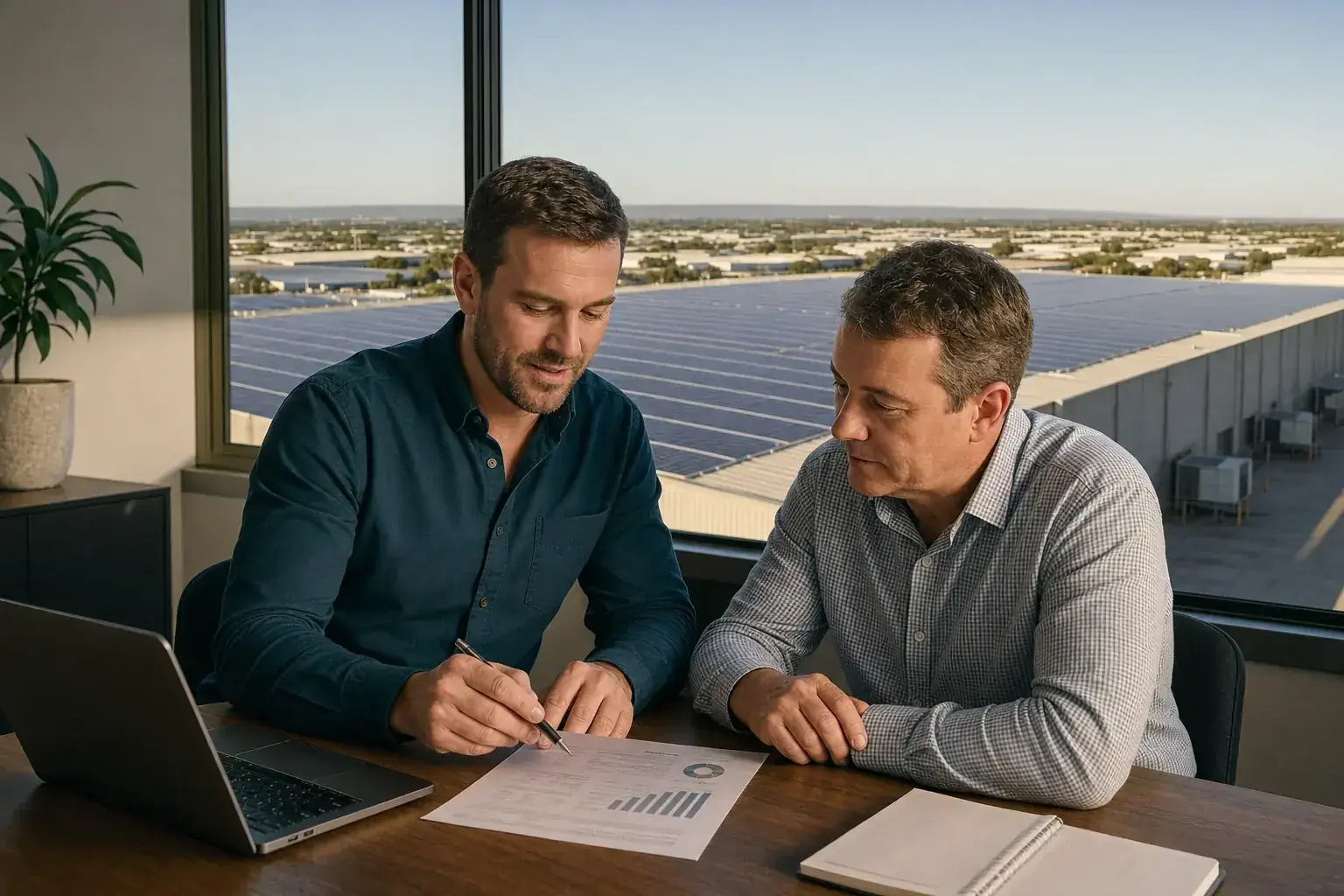
Every kilowatt is costed before you commit. That discipline matters equally whether you are buying or signing a 15-year PPA - the numbers tell the story.
Green Finance: The Loan Option Explained
A commercial green energy loan sits between buying outright and a PPA. You borrow the system cost (or a portion of it), repay monthly, and own the system from settlement. The STC rebate typically reduces the loan principal. Once the loan is repaid, all savings accrue to the business.
The key question is whether the monthly bill saving exceeds the monthly loan repayment - the cash-flow-positive threshold. At current indicative SA electricity prices and system costs, many 5-7 year commercial loans produce a positive monthly cash flow from day one. Confirm this with a finance-adjusted feasibility model for your specific loan rate and system.
- 01Get a loan rate indication from your bank or a green finance specialist
Commercial green loans from specialist lenders often carry competitive rates and understand the solar asset class. Compare these to your existing commercial credit facility.
- 02Calculate the monthly repayment on the net system cost
Subtract the STC rebate from the gross system cost to get the amount to be financed. At your quoted interest rate and preferred term, calculate the monthly repayment.
- 03Model the monthly bill saving
Use the performance model from your installer to estimate the annual bill saving, divide by 12 for a monthly figure.
- 04Compare: saving vs repayment
If the monthly saving exceeds the monthly repayment, the loan is cash-flow positive from day one. If not, assess whether the difference is within acceptable tolerance given the ownership benefits.
Questions to Ask Before Signing Any Finance Arrangement
Whether you are evaluating a PPA, a lease or a direct purchase loan, these questions belong in your due diligence process.
- 1What is the annual escalation rate on the PPA price (or loan interest rate), and how does it compare to expected electricity price increases?
- 2What happens to the contract or asset if the business is sold or the premises are vacated?
- 3Who is responsible for maintenance, inverter replacement and panel cleaning, and are these costs included in the contract?
- 4What are the early-termination penalties, and how are they calculated?
- 5Does the arrangement appear on or off the balance sheet, and how does that interact with existing financing covenants?
- 6Is the STC rebate being passed to me (in a purchase) or retained by the provider (in a PPA/lease)?
- 7Has an independent financial adviser reviewed the proposal against my specific business tax position?
How a commercial solar asset or a PPA is treated under Australian tax law - depreciation, immediate expensing provisions, GST treatment, STC income - depends on your business structure and current tax position. Your accountant or tax adviser should review any significant solar finance arrangement before you sign.
Explore our commercial solar services
About Commercial Solar Adelaide
We design, install and finance commercial solar and battery systems across Adelaide and regional South Australia, built around your load profile and costed before you commit. Our guides are written and reviewed by our accredited team.
How we put this together
Figures in this guide are indicative and based on typical South Australian commercial tariffs, yields and system pricing at the time of writing. Every project is different, so treat these as a starting point, not a quote. For rebate, tax or finance questions, confirm the current detail with the relevant scheme and your accountant.